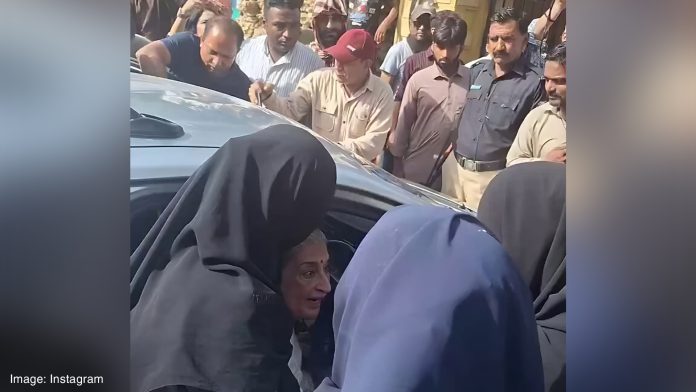
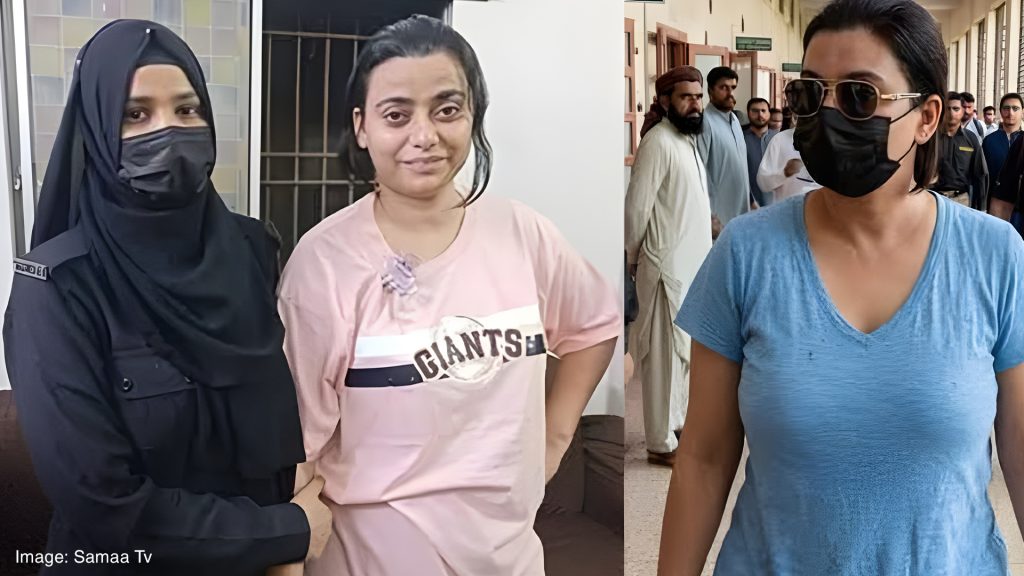
Within the span of days, Karachi produced two images that together ignited one of Pakistan’s most explosive debates about class, policing and power. In the first, Sheema Kermani, a 75-year-old activist, classical dancer and founding organizer of Aurat March, was physically dragged away by veiled female police officers outside the Karachi Press Club while attempting to hold a press conference demanding permission for a peaceful women’s march. In the second, a woman accused of operating one of Pakistan’s most sophisticated cocaine networks walked calmly into court without handcuffs while police officers escorted her through crowds and cameras as though clearing a path for someone important. For millions of Pakistanis watching both moments unfold within days of each other, the contrast was not subtle. It was a mirror held up to the system itself.
Who Sheema Kermani Is And Why It Matters
To understand why the footage of Kermani’s arrest struck such a deep nerve, it is necessary to understand who she is and what she represents.
Kermani founded Tehrik-e-Niswan in 1979, one of Pakistan’s oldest and most enduring women’s rights organizations, at a time when General Zia-ul-Haq’s regime was actively suppressing women’s public presence and treating classical dance with suspicion and hostility. She continued performing openly through those years, becoming a symbol of artistic defiance at a moment when the state was doing everything it could to silence women’s voices in public life. She was nominated for the Nobel Peace Prize in 2005 as part of the 1000 PeaceWomen project. She trained under legendary Indian classical dance teacher Leela Samson and became Pakistan’s leading exponent of Bharatanatyam, a form she kept alive in a country where it faced decades of cultural opposition. An entirely new generation discovered her through Coke Studio’s globally acclaimed track Pasoori, which brought her international recognition late in a career already spanning five decades of resistance.
Days after the 2017 Lal Shahbaz Qalandar bombing that killed 88 people, she performed dhamaal at the shrine in defiance of fear and extremism. That is the woman Karachi’s police dragged into a vehicle for trying to hold a press conference. The Sindh Home Minister personally called her afterward to apologize. Three officers were suspended within 24 hours. The state moved quickly to contain the damage, but the image had already burned itself into public memory.
The Rise Of Pakistan’s Alleged Cocaine Queen
The woman at the center of the other image is Anmol, also known as Pinky, who investigators accuse of running one of the most sophisticated high-end cocaine operations Pakistan has seen.
According to investigative accounts reported across Pakistani media, Anmol allegedly entered elite party circles as a teenager before becoming connected to a lawyer allegedly linked to an international cocaine trafficking network. After that marriage ended she allegedly married a police officer in Lahore and expanded her operations with the assistance of her brothers. Investigators claim she learned to chemically refine cocaine through internet research, experimenting with formulas across multiple failed attempts before producing a product that became, by her own alleged account, a brand.
The operation allegedly functioned with a level of sophistication that distinguished it from ordinary street-level narcotics dealing. Cocaine shipments were allegedly transported from Lahore to Karachi by train through female couriers carrying multiple packets. Upon arrival, motorcycle riders collected separate consignments and distributed them to customers across the city. Network members allegedly operated independently and rarely met directly, a compartmentalized structure designed to prevent any single arrest from unraveling the whole operation. Payments were reportedly made through bank transfers to avoid cash detection.
The alleged product line included standard Anmol Queen cocaine priced at twenty-five thousand rupees per gram, more than double the market rate for ordinary cocaine at ten to twelve thousand, and a premium version called Golden Anmol Queen at forty thousand rupees per gram. Customers allegedly included showbiz figures, athletes, police officers, bureaucrats, wealthy students and members of Karachi and Lahore’s elite social circles. She reportedly had four home delivery riders operating across Karachi and allegedly distributed millions of rupees on the streets on multiple occasions, money that investigators say reflected the scale of what the operation was generating monthly.
The Audio That Made Pakistan Stop
What transformed the story from a major drug bust into a national obsession was not only the arrest or the court footage. It was an audio clip that surfaced online shortly afterward, allegedly capturing Anmol’s own voice.
In the recording, she is heard telling someone that authorities had been trying to arrest her for eight to nine years without success. She reportedly says that the day you start thinking properly you will become a brand like Pinky. She claims she spread darkness across Karachi and dares law enforcement to catch her if they can. The language was extraordinary not because of the bravado alone but because of the framing. A woman accused of running a cocaine empire was describing herself in the vocabulary of entrepreneurship and personal branding while treating law enforcement as an obstacle she had already defeated.
When she then walked into a Karachi courtroom without handcuffs, composed and apparently confident, with a police officer guiding her path, the audio and the footage collapsed into a single image that Pakistan could not look away from.
The Allegations That Explain Everything
The question that dominated public conversation was not simply how she built the network. It was how she kept it running for so long.
Investigators alleged she was wanted in at least ten separate narcotics cases registered across multiple police stations since 2021. Sources further alleged that Punjab Police had arrested her nearly five years ago before releasing her following an alleged bribe payment of seventy million rupees. Those claims remain unproven in court. But they landed in a country already primed to believe that the right connections and the right money can make files disappear, and they dramatically intensified the public conviction that the operation had been shielded by elite protection networks for years.
Investigators also alleged that Anmol owns a hotel in Gilgit, pointing to financial interests stretching well beyond Karachi and raising questions about money laundering across multiple provinces. The geographic reach of the alleged operation, with supply chains allegedly connected to Malaysia, Dubai, Bangkok and Colombia and distribution running from Lahore to Karachi to Islamabad, made it clear that what Pakistan was looking at was not a local dealer who got lucky. It was an allegedly organized transnational narcotics operation that had been hiding in plain sight inside Pakistan’s most elite social spaces.
The Comparison That Broke The Internet
Pakistanis online were quick to note that Griselda Blanco, the Colombian drug lord who built a cocaine empire in the 1970s and 1980s and whose story became the subject of multiple major productions including the Netflix series Griselda, had become a reference point for how Pinky’s story was being discussed. The parallel was not simply about gender. It was about the way criminal power, when exercised with enough sophistication and the right protection, can begin to look like glamour.
The court footage fed that perception directly. Rather than appearing frightened or diminished, the accused walked through the courtroom as though the proceedings were a formality she had already arranged. Inspector General of Sindh Police Javed Alam Odho ordered an inquiry into the no-handcuffs appearance after it went viral. Several officers were suspended. The same institutional machinery that suspended officers for manhandling Sheema Kermani was now suspending different officers for treating an alleged cocaine dealer too gently. Both sets of suspensions happened within days of each other. The same city. The same police force. The same Sindh government. Two opposite failures of exactly the same institution.
What Pakistan Is Actually Arguing About
The debate that erupted across Pakistani social media was never really about narcotics enforcement procedures. It was about something that Pakistanis have felt for a long time but rarely seen illustrated so starkly within the same week in the same city.
Sheema Kermani spent fifty years building something. She fought for women when the state made fighting dangerous. She danced at shrines after bombings. She organized marches, trained students, directed plays about domestic violence and minority rights and kept an art form alive that her country repeatedly tried to bury. She walked to a press club to ask for permission to march peacefully and was dragged into a police vehicle by officers who covered their own faces while doing it.
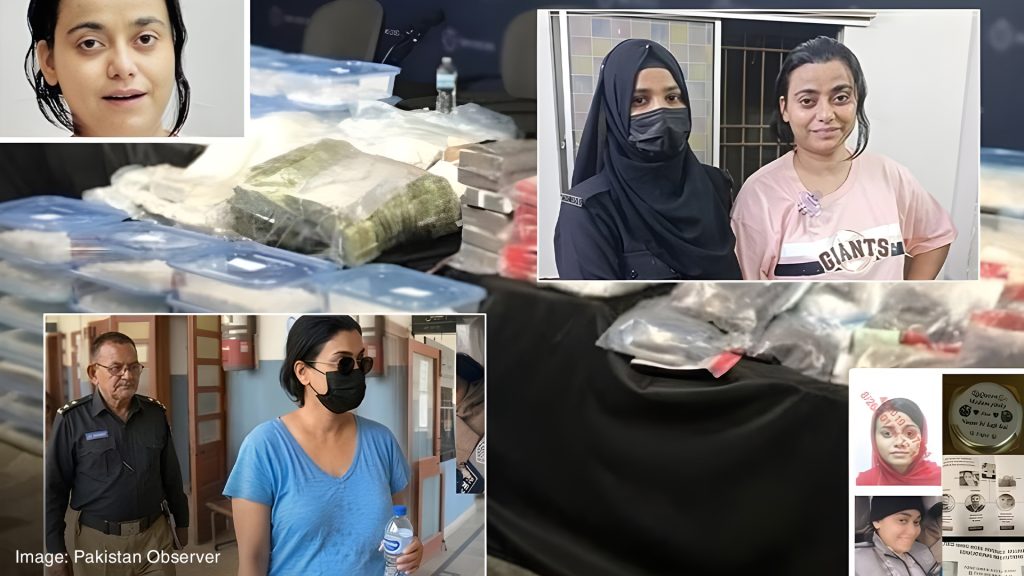
Anmol allegedly spent years supplying white powder to the people who run Pakistan’s institutions, its entertainment industry, its sports, its bureaucracy and its law enforcement. She bragged that no one could touch her. She walked into court without restraints while an officer cleared her way.
Three officers were suspended in both cases. The system registered both as errors to be managed. But for the Pakistanis who watched both images appear within the same week, the error was not procedural. The error was the system working exactly as it was designed to.
Sources: ARY News, Dawn, Geo News, Samaa TV, investigative Urdu reporting by Syed Mehdi Bukhari, Sindh Police statements, The News, Pakistan Today, court footage, Pakistani media investigations.
#Pakistan #Karachi #Pinky #CocaineQueen #SheemaKermani #Crime #SindhPolice #AuratMarch #PakistanNews #Corruption #EliteCulture #GlobalAffairs #BreakingNews #Opinions #Verum