Afghanistan: The Country Where Children Are Made To Watch.

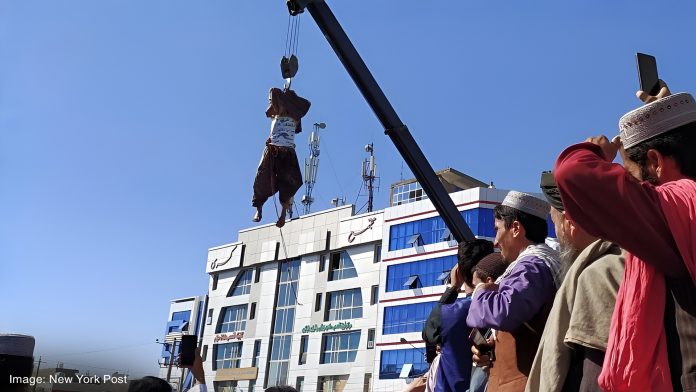
In Khost province, a man was shot to death inside a sports stadium in front of thousands of people, including children. The UN had called for it to be stopped. The Taliban proceeded anyway. That execution is not an outlier. It is the system working as designed.

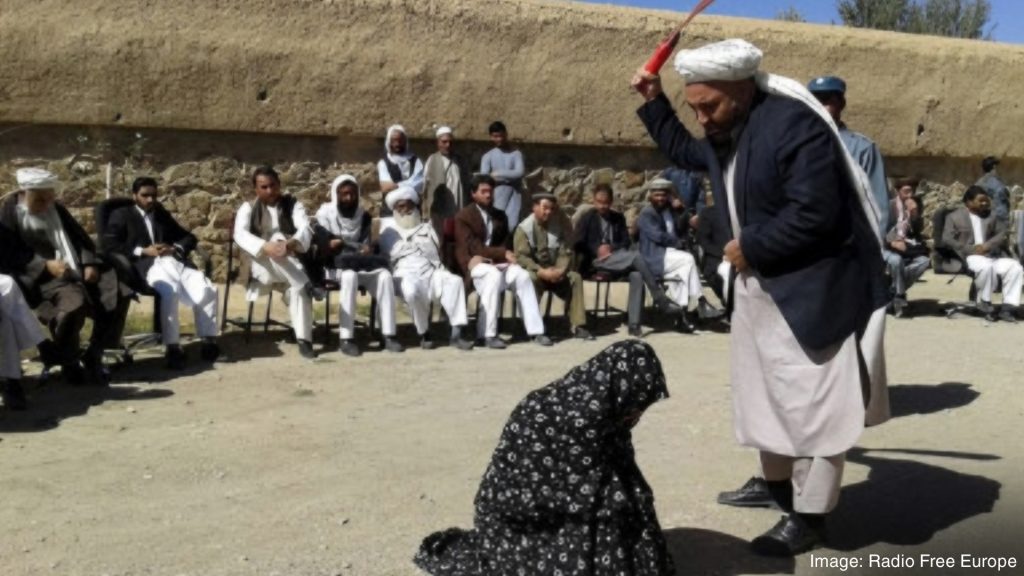
In 2025, Taliban courts announced the public flogging of at least 1,110 people across Afghanistan, including at least 170 women. That figure is nearly double the total recorded in 2024. It is also more than all floggings combined in every year since the Taliban returned to power in 2021. In January 2026 alone, 147 men and 15 women were flogged in a single month, one of the highest monthly totals since the practice was formally reintroduced in late 2022. Early indications suggest 2026 will be worse.

Children Are Being Made To Watch

The most deliberately disturbing element of this system is what it does to children. Public punishments are carried out in front of crowds that include local residents and families. Attendance is not voluntary. Children are compelled to watch lashings, beatings and executions in public squares, stadiums and open gathering areas across multiple provinces.

This is not a byproduct of the Taliban’s punishment system. It is a feature of it. An entire generation of Afghan children is growing up in a society where violence administered by authority figures in public spaces is normalized, expected and inescapable. Aid organizations working in Afghanistan have warned of severe long-term psychological consequences for children raised inside this environment.

And it does not stop at the public square. Under the Taliban’s new Criminal Procedure Code introduced in January 2026, fathers are explicitly permitted to physically punish sons as young as ten for failing to pray. Teachers may beat students as long as the injury does not result in broken bones, torn skin or visible bruising. Husbands are only penalized for beating their wives if that beating causes serious injury and can be proven in court. For Afghan children, the violence follows them from the stadium into the classroom and then into the home. There is no room where it is not permitted.
A Legal Code Built Around Fear

The January 2026 Criminal Procedure Code contains 119 articles issued without public consultation or legislative process. Legal analysts at Princeton, Oxford and The Diplomat have all described it as a framework designed not to deliver justice but to consolidate control.

The code establishes a four-tier class system under which religious scholars and Taliban elites face little more than warnings for infractions, while ordinary citizens face flogging, imprisonment and execution. It makes it a criminal offense to fail to report “subversive” meetings to authorities, effectively turning neighbors into informants. A Kabul-based lawyer told The Diplomat: “Under this code, neighbors become informants. You can no longer trust anyone. This is how the Taliban want to rule, through fear and betrayal.”

Criticism of the Taliban is explicitly punishable. A man in Kapisa province received 39 lashes and a prison sentence for what Taliban authorities described as “propaganda against the system.” Another in Badghis was flogged for allegedly insulting the Taliban leader. And the word “slave” appears across multiple sections of the code, acknowledged and left without definition or legal consequence.

Women and Girls Under Gender Apartheid

More than 150 Taliban edicts now regulate nearly every aspect of life for Afghan women and girls. Girls remain banned from secondary schools and universities. Women face restrictions on employment, movement and public appearance. UN experts, Afghan women’s organizations and Princeton’s School of Public and International Affairs now formally describe the system as gender apartheid.

78% of young Afghan women are not in education, employment or training, nearly four times the rate for young men. UN Women projects that early childbearing will rise by 45% by 2026 as a direct consequence. UNICEF warns Afghanistan could face a deficit of more than 25,000 female teachers and healthcare workers by 2030. In January 2026, women who had been ordered to stay home since 2021 while receiving a reduced government salary were informed without notice that their employment was terminated and their pay would stop entirely.

Since September 2025, the Taliban has banned Afghan women, including UN staff, from entering UN premises across the country. The organization responsible for monitoring and reporting these abuses cannot get its own people into their offices.
The World Has Stopped Watching

Nearly 1.45 million Afghans were deported back to Taliban-controlled Afghanistan in 2025 from Pakistan, Iran, Turkey and Tajikistan. Many fled Taliban rule the first time. They are now being returned to a legal system with no independent judiciary, no fair trial guarantees and punishments determined by confession, ideology and the personal interpretation of Taliban officials.

Meanwhile, international media coverage of Afghanistan has collapsed. Most outlets now treat the country as a humanitarian story rather than a political and legal one. The Diplomat noted explicitly that Western media have deprioritized Afghanistan in favor of Ukraine, Gaza and the Indo-Pacific.

An entire generation of Afghan children is growing up believing that justice means a whip in a public square. The international community spent twenty years and trillions of dollars trying to prevent exactly that. It has now stopped watching.

#Afghanistan  #Taliban  #Flogging  #GenderApartheid  #AfghanWomen  #ChildRights  #HumanRights  #Femicide  #UN  #Verum

Sources: OHCHR, UN News, Amu TV, Human Rights Watch, The Diplomat, Oxford Human Rights Hub, Princeton SPIA, Bush Center, UNICEF, Kabul Now, Euronews, Feminist Majority Foundation.


In Khost province, a man was shot to death inside a sports stadium in front of thousands of people, including children. The UN had called for it to be stopped. The Taliban proceeded anyway. That execution is not an outlier. It is the system working as designed.

In 2025, Taliban courts announced the public flogging of at least 1,110 people across Afghanistan, including at least 170 women. That figure is nearly double the total recorded in 2024. It is also more than all floggings combined in every year since the Taliban returned to power in 2021. In January 2026 alone, 147 men and 15 women were flogged in a single month, one of the highest monthly totals since the practice was formally reintroduced in late 2022. Early indications suggest 2026 will be worse.

Children Are Being Made To Watch

The most deliberately disturbing element of this system is what it does to children. Public punishments are carried out in front of crowds that include local residents and families. Attendance is not voluntary. Children are compelled to watch lashings, beatings and executions in public squares, stadiums and open gathering areas across multiple provinces.

This is not a byproduct of the Taliban’s punishment system. It is a feature of it. An entire generation of Afghan children is growing up in a society where violence administered by authority figures in public spaces is normalized, expected and inescapable. Aid organizations working in Afghanistan have warned of severe long-term psychological consequences for children raised inside this environment.

And it does not stop at the public square. Under the Taliban’s new Criminal Procedure Code introduced in January 2026, fathers are explicitly permitted to physically punish sons as young as ten for failing to pray. Teachers may beat students as long as the injury does not result in broken bones, torn skin or visible bruising. Husbands are only penalized for beating their wives if that beating causes serious injury and can be proven in court. For Afghan children, the violence follows them from the stadium into the classroom and then into the home. There is no room where it is not permitted.

A Legal Code Built Around Fear

The January 2026 Criminal Procedure Code contains 119 articles issued without public consultation or legislative process. Legal analysts at Princeton, Oxford and The Diplomat have all described it as a framework designed not to deliver justice but to consolidate control.

The code establishes a four-tier class system under which religious scholars and Taliban elites face little more than warnings for infractions, while ordinary citizens face flogging, imprisonment and execution. It makes it a criminal offense to fail to report “subversive” meetings to authorities, effectively turning neighbors into informants. A Kabul-based lawyer told The Diplomat: “Under this code, neighbors become informants. You can no longer trust anyone. This is how the Taliban want to rule, through fear and betrayal.”

Criticism of the Taliban is explicitly punishable. A man in Kapisa province received 39 lashes and a prison sentence for what Taliban authorities described as “propaganda against the system.” Another in Badghis was flogged for allegedly insulting the Taliban leader. And the word “slave” appears across multiple sections of the code, acknowledged and left without definition or legal consequence.

Women and Girls Under Gender Apartheid

More than 150 Taliban edicts now regulate nearly every aspect of life for Afghan women and girls. Girls remain banned from secondary schools and universities. Women face restrictions on employment, movement and public appearance. UN experts, Afghan women’s organizations and Princeton’s School of Public and International Affairs now formally describe the system as gender apartheid.

78% of young Afghan women are not in education, employment or training, nearly four times the rate for young men. UN Women projects that early childbearing will rise by 45% by 2026 as a direct consequence. UNICEF warns Afghanistan could face a deficit of more than 25,000 female teachers and healthcare workers by 2030. In January 2026, women who had been ordered to stay home since 2021 while receiving a reduced government salary were informed without notice that their employment was terminated and their pay would stop entirely.

Since September 2025, the Taliban has banned Afghan women, including UN staff, from entering UN premises across the country. The organization responsible for monitoring and reporting these abuses cannot get its own people into their offices.

The World Has Stopped Watching

Nearly 1.45 million Afghans were deported back to Taliban-controlled Afghanistan in 2025 from Pakistan, Iran, Turkey and Tajikistan. Many fled Taliban rule the first time. They are now being returned to a legal system with no independent judiciary, no fair trial guarantees and punishments determined by confession, ideology and the personal interpretation of Taliban officials.

Meanwhile, international media coverage of Afghanistan has collapsed. Most outlets now treat the country as a humanitarian story rather than a political and legal one. The Diplomat noted explicitly that Western media have deprioritized Afghanistan in favor of Ukraine, Gaza and the Indo-Pacific.

An entire generation of Afghan children is growing up believing that justice means a whip in a public square. The international community spent twenty years and trillions of dollars trying to prevent exactly that. It has now stopped watching.

#Afghanistan  #Taliban  #Flogging  #GenderApartheid  #AfghanWomen  #ChildRights  #HumanRights  #Femicide  #UN  #Verum

Sources: OHCHR, UN News, Amu TV, Human Rights Watch, The Diplomat, Oxford Human Rights Hub, Princeton SPIA, Bush Center, UNICEF, Kabul Now, Euronews, Feminist Majority Foundation.

spot_img

Explore more

spot_img
Global Affairs

British Muslims Say They No Longer Feel Safe. The Attacks Are...

Britain Is Getting Its Seventh Prime Minister In A Decade.

Pakistan Helped Build A Peace Roadmap in Switzerland. Isr*el And Its...

The Lebanon Ceasefire Was Supposed To Stop The Strikes. It Barely...

The Plan To End Al-Aqsa Has Already Started.

Congress Just Made Isr*el Harder To Hold Accountable

The War On Pakistan’s Trade Routes

Isr*el Wasn’t At The Table. But Its War In Lebanon Just...