Balochistan’s Viral Independence Claim Unfolds Alongside a Confirmed Data Breach and Spy Rivalry
Maryam Tariq
A social media post claiming the creation of an independent Republic of Balochistan went viral this week, complete with a flag, a national anthem and a new currency. The declaration is symbolic and carries no legal or diplomatic weight, but it landed at a moment when the region is genuinely at the center of overlapping security crises, a real insurgency, a confirmed cyber espionage breach, and long standing accusations between Pakistan and India over who is really destabilizing whom.
The Viral Declaration and What It Actually Claims
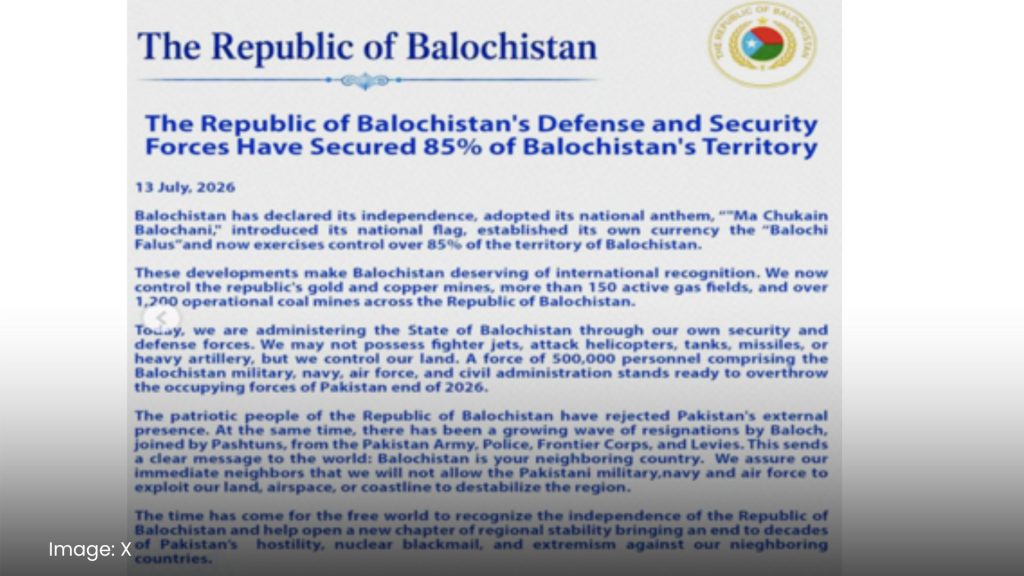
The trend began after Baloch nationalist activist Mir Yar Baloch shared a statement on X announcing the formation of a new state administration, including the anthem Ma Chukain Balochani and a currency called the Balochi Falus. The statement claimed Baloch security forces had secured 85 percent of the region’s territory, including its gold, copper and gas reserves, and appealed to the United Nations for recognition and peacekeeping support, as well as to India for permission to open a Baloch embassy in New Delhi. Independent defense and intelligence tracking has found these territorial claims to be false, and no country or international body has granted any form of recognition. The viral moment coincided with Operation Shaban, a large Pakistani military counter insurgency sweep launched after a surge in coordinated attacks by the Baloch Liberation Army.

Pakistan’s Accusation Against India
Islamabad has long maintained that India’s Research and Analysis Wing provides financial and logistical support to militant groups operating in Balochistan, including the BLA, with the stated goal of tying down Pakistan’s military and disrupting the China Pakistan Economic Corridor. India rejects these allegations outright and frames itself as a victim of cross border terrorism originating from Pakistani soil. Neither government has presented evidence that has satisfied international bodies on this point, and the accusation remains a central, unresolved feature of the diplomatic relationship between the two countries.
A Confirmed Breach of Balochistan’s Police Data
Separately from the viral claims and diplomatic accusations, a real and independently documented security event has unfolded. Cybersecurity researchers at SentinelLabs disclosed that suspected China linked and India linked hackers breached several Pakistani law enforcement systems between February 2024 and April 2026, with Balochistan Police among the most heavily targeted. Compromised servers hosted biometric records, criminal case files, personnel records, and citizen facing complaint systems. Researchers noted that the China linked activity overlapped with broader espionage campaigns targeting Chinese nationals working on Belt and Road projects in the region, suggesting an interest in assessing threats to that personnel. The India linked activity, researchers said, aligns with the long running tension between Islamabad and New Delhi, though attribution based on shared hacking tools remains difficult to confirm with full certainty.
Why This Kind of Data Is Valuable to Intelligence Services
Security analysts warn that access to biometric and personnel data effectively maps the human landscape of a conflict zone, allowing outside actors to identify government officials, track security personnel, and pinpoint local dissidents or informants. This is not a hypothetical concern. SentinelLabs explicitly noted that access to these databases can expose the identities of officers and informants and reveal active investigative priorities.
The Surveillance Risk Analysts Are Watching
A further concern raised by analysts, though not something confirmed to have occurred in Pakistan specifically, is the possibility that leaked identity data could eventually be combined with camera or facial recognition access to enable what is sometimes called pattern of life tracking, a method associated with high profile intelligence operations targeting Iranian military and political figures in recent years. Analysts describe this as a documented risk profile worth monitoring given the scale of Balochistan’s data exposure, rather than an event that has been verified to have happened in this case.

What This Means Going Forward
Balochistan currently sits at the intersection of a viral but legally meaningless independence claim, a genuine and ongoing insurgency, a confirmed multi year cyber espionage campaign against its police infrastructure, and an unresolved accusation between two nuclear armed neighbors. None of these threads confirm the others, but together they describe a region where information, not just territory, has become a central battleground.
Sources:
· Hackers Weaponize Balochistan Police Portal in Multi-Group Espionage Campaigns — The Hacker News: https://thehackernews.com/2026/07/hackers-weaponize-balochistan-police.html
· China- and India-linked Hackers Breach Balochistan Police Data — CloudLink Tech: https://www.cloudlinktech.com/news/china-india-linked-hackers-breach-balochistan-police-data/
· Big Data Leak in Pakistan, Where Is the Government Control — The Media Line: https://themedialine.org/top-stories/big-data-leak-in-pakistan-where-is-the-government-control/
· Pakistan deals with fallout of big data leak, with questions over government control — The Jerusalem Post: https://www.jpost.com/middle-east/article-867335