
By Shizza Umer
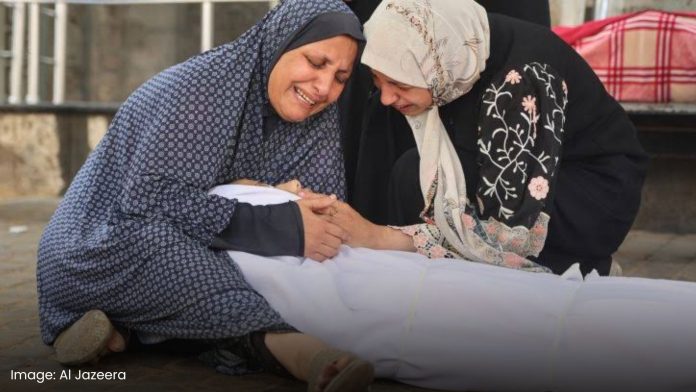
Suzzane Calgaret says her sister Heather could hold her newborn baby with only one arm, because she was still shackled. Heather gave birth while in custody in Victoria in 2019. Her family told an Australian Senate inquiry what happened.
Years later, that account sits at the centre of a national argument. On 15 October 2026, according to Guardian Australia, Labor and the Coalition blocked a vote on legislation that would have prohibited shackling during childbirth nationwide. Senators did not vote to legalise the practice. They stopped the proposed ban from progressing.

A Mother, a Newborn and One Free Arm
Suzzane told the inquiry that Heather remained restrained while holding her baby for the first time, and that she was returned to custody two hours later. The testimony carried further than any legal argument: a mother unable to cradle her own newborn with both arms.
Heather was a First Nations mother of four. Her experience sits inside a wider pattern. In the June 2026 quarter, Aboriginal and Torres Strait Islander people made up 37% of everyone in custody in Australia. They represented roughly 3.8% of the national population in June 2021, and the Australian Human Rights Commission identifies First Peoples women as the fastest-growing prisoner population in the country.
That gap is why First Nations advocates argue failures in custodial maternity care land unequally.
When Medical Care Meets Security Restraints
Formerly incarcerated advocate Tahlia Isaac, founder of Project:herSELF, described another woman who went into premature labour while pregnant with twins. Isaac said officers handcuffed her in the back of a van and took her away.
A separate account came from a woman identified only as Yannetty. She was six months pregnant, handcuffed and shackled at the ankles for transport to a medical appointment, and driven in heat above 40 degrees. She said she was frightened of falling, frightened of fainting, frightened for her baby. Her account describes transport during pregnancy, not delivery.
Health advocates warn restraints restrict movement, complicate examination and slow emergency response. Labour can require rapid changes of position and unobstructed access for medical staff. Thorpe has argued that even a short delay to an emergency caesarean can be devastating for a baby.

Every Witness Backed It. The Committee Said No Anyway.
Independent senator Lidia Thorpe introduced the bill in August. It would prohibit physical, mechanical, chemical and environmental restraints during labour, childbirth, and immediately before and after birth, with no officer discretion.
Thorpe said every witness and every written submission supported passing it. The committee recommended against passage anyway, and said so in unusual terms: despite having views on the need for reform in this area, it had no choice but to not recommend the bill be passed.
It recommended two things instead. That the Commonwealth engage with states and territories. And that the government start collecting national data on how many women are pregnant or give birth in custody each year, because Australia does not currently maintain comprehensive figures.
The International Standard Without a National Law
The UN General Assembly adopted the Bangkok Rules in December 2010. Rule 24 states that restraints should never be used on women during labour, birth and immediately after. Australia supported them. They are international standards, not an enforceable Australian statute.
Corrections are run by the states and territories, and policies differ. Thorpe’s argument is that the policies that exist contain exemptions, and the exemptions are how this keeps happening. Those guidelines often create exemptions, she told Parliament, which lead to the person being shackled anyway.
Labor argued corrections and criminal justice sit principally with state and territory governments. The Coalition said it understood the bill’s intention but would not support its passage.
Two Bills, One Unresolved Day
Thorpe’s companion bill to prohibit strip-searching anyone under 18 was blocked the same day. Liberal senator Paul Scarr criticised the practice, said he would write to Queensland’s attorney general and called on the prime minister to convene National Cabinet.
Thorpe has promised to keep going. What remains unanswered is whether Australia will replace a patchwork of state policies with one binding national protection, and when governments will start counting the births their own parliamentary committee asked them to count.
By Shizza Umer
SOURCES
The Guardian: Labor and Coalition block bill that would ban incarcerated women being shackled in childbirth, 15 October 2026
The Guardian: Shackling prisoners giving birth should be a last resort, Tory Shepherd, 22 September 2026
National Indigenous Times: Inquiry rejects bill to ban shackling during childbirth, 8 October 2026
https://nit.com.au/08-10-2026/26855/inquiry-rejects-bill-to-ban-shackling-during-childbirth
National Indigenous Times: Advocates urge federal parliament to pass Thorpe bill, 9 September 2026
ABC News: Heather Calgaret’s death in custody was preventable, coroner finds, 28 July 2025
Australian Parliament: Crimes Amendment (Prohibiting Shackling During Childbirth) Bill 2026
Australian Parliament: Legal and Constitutional Affairs Legislation Committee inquiry
United Nations: Bangkok Rules, Resolution 65/229
https://docs.un.org/A/RES/65/229
Australian Bureau of Statistics: Corrective Services Australia, June quarter 2026
Australian Bureau of Statistics: Estimates of Aboriginal and Torres Strait Islander Australians
Australian Human Rights Commission: Human Rights Assessment 2026, Criminal Justice