
Texas has approved a sweeping rewrite of what students will learn about history and religion, and the contrast between its treatment of Isr.ael, Biblical history and Islam has triggered fierce opposition from Muslim students, parents and civil-rights groups.
The changes are part of revisions to the state’s Texas Essential Knowledge and Skills, the standards used across Texas public schools. They reach classrooms in the 2030-2031 school year.
The controversy is not simply about what Texas decided to include. It is about the language and historical lens used when different religions enter the curriculum.
Isr.ael Through Homeland, Heritage And America
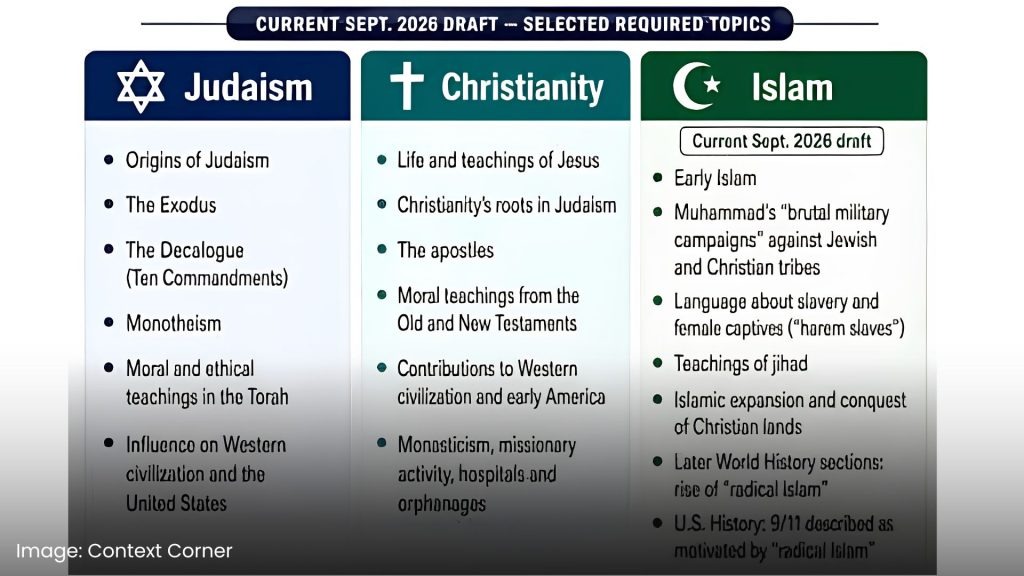
One of the most striking additions concerns modern Isr.ael. Students will learn about the establishment of Isr.ael in 1948 in connection with the ancestral homeland of the Jewish people. The evangelical pro-Isr.ael organization Proclaiming Justice to the Nations said Texas accepted several of its curriculum recommendations, which emphasized Judeo-Christian influence on the United States.
But the favorable framing begins much earlier than high school.
Grade 3 carries a dedicated section titled Ancient Israel and Connections to America and Texas, covering the Exodus, the Promised Land and the Ten Commandments, and requiring students to explain how the Hebrew idea of a chosen people with a promised land influenced Puritans who moved to North America. Grade 3 also carries a dedicated Christianity section. There is no equivalent section for Islam anywhere in the elementary standards.
From Kindergarten upward, every grade embeds the same statutory line: Hebrew Scriptures, the Old Testament and New Testament, and their impact on history and literature. No other scripture is named at any grade.
One board member did propose that Grade 7 students learn how the displacement of Palestinian Arabs shaped the region. The amendment document shows that language set against the existing standard, which describes Isr.ael being established in 1948 with increased international support following the Holocaust and makes no mention of displacement. Whether the amendment passed has not been publicly confirmed, and no account of the adopted standards records displacement language surviving.

Biblical Material Goes Much Further
In a separate June 26 decision, the board approved the nation’s first statewide K-12 required reading list, spanning over 150 titles and including Bible passages alongside Anne Frank’s diary, Elie Wiesel’s Night and Washington’s 1790 letter to a Rhode Island synagogue. Frank’s diary is an anchor text for seventh grade. That requirement came from the June vote and should not be confused with the September social-studies revisions.
Supporters argue Biblical texts are essential to understanding American history. Critics, including Americans United for Separation of Church and State, say the standards extol Christianity’s historical influence while treating Islam with hostility.
Then Look At The Language Used For Islam
High-school students will be required to learn that radical Islam motivated the 9/11 attacks, rather than focusing on al-Qaeda and the individuals responsible. Early Islamic history is taught through Prophet Muhammad’s brutal military campaigns against Jewish and Christian tribes, the normalization and regulation of slavery, and the taking of female captives as harem slaves.
The hostility is not confined to high school either. Grade 4 students must explain that the purpose of the Crusades was to reclaim Christian control of the Holy Land and Jerusalem after previous Muslim conquests. The entire Grade 4 requirement on Mali is to identify how Mansa Musa’s wealth from gold, salt and the slave trade inspired exploration. The richest Muslim empire in African history appears once, attached to the slave trade.
The language was controversial among the board’s own appointed advisers. At least three raised concerns about the characterisation. Curriculum adviser Andrea Hutchison said it did not withstand close historical scrutiny, and University of Texas at Austin professor Robert Koons warned against claims not supported by well-established secular sources. The board retained the disputed wording.


What Texas Removed Matters Too
The board had eliminated a standard requiring students to learn about Muslim contributions to algebra and astronomy, and it was not restored. A review by the Dallas Morning News found that almost every drafted standard mentioning Islam connected it to slavery, conquest or conflict.
Muslim Texans Fought The Changes, And Were Argued Out Of The Room
Muslim students and organisations objected repeatedly. One 15-year-old Muslim student told board members the curriculum made her feel as though her religion did not belong. The Council on American-Islamic Relations called on the board to remove biased and hostile language before the final vote, and said afterward that no credible scholar of history validates the caricatures of Islam this curriculum teaches.
Board members repeatedly attempted to prevent CAIR from testifying at all, citing Governor Greg Abbott’s designation of the group as a foreign terrorist organisation. CAIR has sued, calling the label defamatory and false, and a federal judge has already blocked the near-identical order in Florida. The group objecting to the language was being argued out of the room using a label a court has already struck down elsewhere.
The controversy has spilled beyond education. Houston Muslim leaders have launched a voter-registration campaign targeting roughly 1,000 registrations per week at mosques, citing anger over the curriculum changes.
The Question Isn’t Whether Students Should Learn About Isr.ael
Teaching the history of Isr.ael, Judaism, Christianity, the Holocaust or Biblical literature is not inherently evidence of political bias. Neither is teaching difficult episodes of Islamic history inherently anti-Muslim.
The controversy comes from selection and framing.
A Texas child starting school in 2030 will spend thirteen years learning that one tradition is the moral foundation of American law, and meeting the other mainly through conquest, slavery and 9/11.
That is why the argument over Texas classrooms is no longer simply about what history should be taught. It is about which parts of each history Texas chooses to make defining.
By Shizza Umer
Sources
Texas Education Agency, Proposed Social Studies TEKS
Texas State Board of Education, Adoption Announcement
Texas State Board of Education, Reveles Amendment
The Texas Tribune, August 31, 2026
The Texas Tribune, April 10, 2026
Texas Public Radio, September 7, 2026
Jewish Telegraphic Agency, June 26, 2026