
China Is Pulling Ahead. Is the West Getting Dumber?

China Is Pulling Ahead. Is the West Getting Dumber?

The latest results from one of the world’s biggest education assessments have produced an uncomfortable picture: student performance across much of the developed world has fallen sharply, while several East Asian education systems remain far ahead.

The OECD’s Programme for International Student Assessment, better known as PISA, evaluates how effectively 15-year-olds can apply their knowledge in reading, mathematics and science. The 2025 assessment involved more than 760,000 students across 91 countries and economies, making it an unusually broad snapshot of global education.

And the latest numbers are difficult to dismiss.

Reading and Maths Have Fallen to Historic Lows

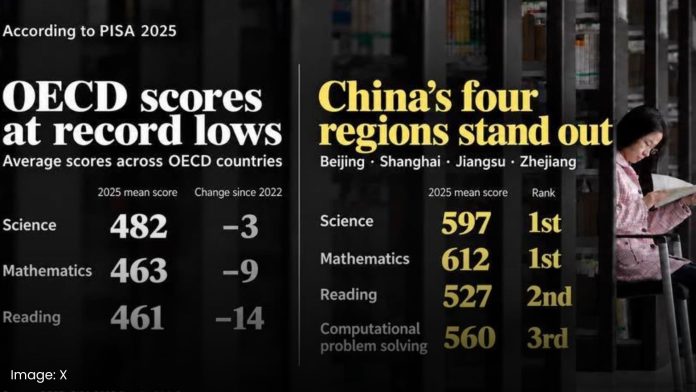
Across OECD countries, average reading performance fell to approximately 461 points, compared with 489 in 2015. That 28-point decline is equivalent to roughly a year and a half of learning under commonly used PISA interpretations.

Mathematics has followed a similar trajectory, falling from around 485 points in 2015 to 463 in the latest assessment.

Science has proved more resilient but remains below longer-term historical performance.

Perhaps more troubling is the growing number of teenagers struggling across the board. Around one in five OECD students is now considered a low performer in reading, mathematics and science simultaneously, compared with roughly 16% in 2022.

But on the other side of the rankings sits an extraordinary result.
China’s Top Regions Are Operating at Another Level

The Chinese participant commonly described in PISA comparisons as B-S-J-Z represents Beijing, Shanghai, Jiangsu and Zhejiang.

Its mathematics score reached approximately 612, compared with an OECD average of 463.

That is not a marginal advantage. It represents an enormous performance gap.

More than half of students in these Chinese regions reached the highest proficiency levels in mathematics, while only a small fraction of students across the OECD achieved the same.

Other East Asian systems, including Singapore, Japan, South Korea, Macao, Hong Kong and Chinese Taipei, also remain among the strongest performers internationally.

But there is an important qualification that disappears remarkably quickly whenever the rankings become social-media ammunition.

This Is Not a National Sample of China

B-S-J-Z does not represent China as a whole.

Beijing, Shanghai, Jiangsu and Zhejiang are among China’s wealthiest and most educationally developed regions. Researchers have questioned for years whether their results can reasonably be compared with nationally representative samples from countries such as the United States or United Kingdom.

Concerns have also been raised about rural representation and the effect of China’s hukou household-registration system, particularly on migrant students and access to urban schools.

The OECD itself has made clear that these participating regions should not simply be interpreted as a nationally representative Chinese result.

That does not make the scores meaningless. The students tested genuinely produced exceptional results. It means claims that “China scored 612” require context.

And another country makes the simplistic East-versus-West narrative even harder to sustain: Britain.

Britain Complicates the Western-Decline Narrative

The United Kingdom remains among the stronger-performing education systems internationally.

The United States presents a more mixed picture. American reading performance remains comparatively strong internationally, while mathematics continues to be a significant weakness.

There are also methodological cautions surrounding the latest US results, including OECD concerns about participation and exclusion rates. Those caveats make sweeping national comparisons even more hazardous.

Elsewhere, several countries improved in at least some areas, including nations in Eastern Europe, the Middle East, Asia and Latin America.

So PISA 2025 does not reveal a clean geographical contest between a declining West and an ascendant East.

Something more complicated is happening.

Are Phones Destroying Students’ Attention?

Around 28% of OECD students report being distracted by other students using digital devices during most or every science lesson.

In several high-performing East Asian systems, reported classroom distraction is dramatically lower.

Students reporting frequent digital distraction also tend to perform worse academically, even after researchers account for socioeconomic differences.

That association matters, but it does not prove that smartphones caused the decline.

The same warning becomes even more important when discussing artificial intelligence.

Nearly Half of Students Are Already Using AI to Learn

Approximately 46% of students across participating OECD systems report using AI chatbots weekly for learning.

Some patterns are concerning. Students reporting certain forms of AI use, including assistance with summarising, drafting and research tasks, recorded lower science performance, on average scoring around 20 points below students who do not use AI this way.

But correlation is not causation.

Lower-performing students may simply be more likely to seek AI assistance. Differences in schools, socioeconomic circumstances, motivation and learning habits can also affect both AI usage and academic performance.

The OECD’s broader message is therefore considerably more nuanced than “AI makes students stupid.” As OECD education director Andreas Schleicher put it, “the goal should not be to make learning effortless, the goal should be to make learners stronger”.

Technology can strengthen education when used deliberately. The danger comes when it begins replacing the attention, effort and understanding that learning itself requires.

Students Are Also Reading Differently

Another revealing indicator is the rise of “hasty reading,” where students move through material quickly but inaccurately.

The proportion exhibiting this behaviour has nearly doubled since 2018, reaching roughly 9%.

Attendance presents another warning sign. Absenteeism and lateness remain widespread across many education systems, while reported family engagement with students’ learning has also weakened compared with previous assessments.

These factors overlap with another persistent divide: socioeconomic inequality.

Advantaged OECD students outperform disadvantaged students by approximately 85 points in science.

Although that gap has narrowed somewhat, the reason is hardly reassuring. In several comparisons, the narrowing occurred partly because higher-performing and more advantaged students deteriorated, rather than because disadvantaged students suddenly caught up.

COVID Cannot Explain Everything

The pandemic undoubtedly disrupted education.

But PISA’s own historical trend data show international performance problems were already emerging before COVID-19, and the latest results do not support a simple relationship in which countries with longer school closures automatically suffered the greatest declines.

That matters because blaming the pandemic alone risks ignoring deeper structural changes in how teenagers learn, read, attend school and interact with technology.

PISA itself should also be kept in perspective. It tests 15-year-olds at a particular moment and emphasizes applying knowledge to problems. It does not measure every aspect of intelligence, creativity, education quality or future success.

So, is the West getting dumber?

PISA cannot answer that question.

What it can show is arguably more important.

Large numbers of students across advanced economies are performing substantially worse in fundamental academic skills than comparable students did a decade ago. At the same time, some education systems have maintained extraordinarily high standards.

The most important divide may therefore not be China versus the West.

It may be between education systems that are still successfully protecting attention, attendance, engagement and deep learning, and those discovering what happens when those foundations begin to disappear.

By Shizza Umer

Sources

OECD, Programme for International Student Assessment (PISA) 2025 Results (Volume I)

OECD, PISA 2025 press release

OECD, PISA 2025 United States Country Note

Newsweek, “Map Shows Which Countries Outscore US in Reading and Math”

K-12 Dive, “4 Key Takeaways From the Latest PISA Results”

NORRAG, “How (Un)representative Are China’s Stellar PISA Results?”

The 74, “The Strange Case of China and Its Top PISA Rankings”

The PIE News, “China’s PISA Results Not Representative, Say Experts”

MercoPress, “Latin America Falls Back in PISA 2025”

Bernama, “PISA 2025: Malaysian Students Show Strong Willingness To Learn”

China Is Pulling Ahead. Is the West Getting Dumber?

The latest results from one of the world’s biggest education assessments have produced an uncomfortable picture: student performance across much of the developed world has fallen sharply, while several East Asian education systems remain far ahead.

The OECD’s Programme for International Student Assessment, better known as PISA, evaluates how effectively 15-year-olds can apply their knowledge in reading, mathematics and science. The 2025 assessment involved more than 760,000 students across 91 countries and economies, making it an unusually broad snapshot of global education.

And the latest numbers are difficult to dismiss.

Reading and Maths Have Fallen to Historic Lows

Across OECD countries, average reading performance fell to approximately 461 points, compared with 489 in 2015. That 28-point decline is equivalent to roughly a year and a half of learning under commonly used PISA interpretations.

Mathematics has followed a similar trajectory, falling from around 485 points in 2015 to 463 in the latest assessment.

Science has proved more resilient but remains below longer-term historical performance.

Perhaps more troubling is the growing number of teenagers struggling across the board. Around one in five OECD students is now considered a low performer in reading, mathematics and science simultaneously, compared with roughly 16% in 2022.

But on the other side of the rankings sits an extraordinary result.

China’s Top Regions Are Operating at Another Level

The Chinese participant commonly described in PISA comparisons as B-S-J-Z represents Beijing, Shanghai, Jiangsu and Zhejiang.

Its mathematics score reached approximately 612, compared with an OECD average of 463.

That is not a marginal advantage. It represents an enormous performance gap.

More than half of students in these Chinese regions reached the highest proficiency levels in mathematics, while only a small fraction of students across the OECD achieved the same.

Other East Asian systems, including Singapore, Japan, South Korea, Macao, Hong Kong and Chinese Taipei, also remain among the strongest performers internationally.

But there is an important qualification that disappears remarkably quickly whenever the rankings become social-media ammunition.

This Is Not a National Sample of China

B-S-J-Z does not represent China as a whole.

Beijing, Shanghai, Jiangsu and Zhejiang are among China’s wealthiest and most educationally developed regions. Researchers have questioned for years whether their results can reasonably be compared with nationally representative samples from countries such as the United States or United Kingdom.

Concerns have also been raised about rural representation and the effect of China’s hukou household-registration system, particularly on migrant students and access to urban schools.

The OECD itself has made clear that these participating regions should not simply be interpreted as a nationally representative Chinese result.

That does not make the scores meaningless. The students tested genuinely produced exceptional results. It means claims that “China scored 612” require context.

And another country makes the simplistic East-versus-West narrative even harder to sustain: Britain.

Britain Complicates the Western-Decline Narrative

The United Kingdom remains among the stronger-performing education systems internationally.

The United States presents a more mixed picture. American reading performance remains comparatively strong internationally, while mathematics continues to be a significant weakness.

There are also methodological cautions surrounding the latest US results, including OECD concerns about participation and exclusion rates. Those caveats make sweeping national comparisons even more hazardous.

Elsewhere, several countries improved in at least some areas, including nations in Eastern Europe, the Middle East, Asia and Latin America.

So PISA 2025 does not reveal a clean geographical contest between a declining West and an ascendant East.

Something more complicated is happening.

Are Phones Destroying Students’ Attention?

Around 28% of OECD students report being distracted by other students using digital devices during most or every science lesson.

In several high-performing East Asian systems, reported classroom distraction is dramatically lower.

Students reporting frequent digital distraction also tend to perform worse academically, even after researchers account for socioeconomic differences.

That association matters, but it does not prove that smartphones caused the decline.

The same warning becomes even more important when discussing artificial intelligence.

Nearly Half of Students Are Already Using AI to Learn

Approximately 46% of students across participating OECD systems report using AI chatbots weekly for learning.

Some patterns are concerning. Students reporting certain forms of AI use, including assistance with summarising, drafting and research tasks, recorded lower science performance, on average scoring around 20 points below students who do not use AI this way.

But correlation is not causation.

Lower-performing students may simply be more likely to seek AI assistance. Differences in schools, socioeconomic circumstances, motivation and learning habits can also affect both AI usage and academic performance.

The OECD’s broader message is therefore considerably more nuanced than “AI makes students stupid.” As OECD education director Andreas Schleicher put it, “the goal should not be to make learning effortless, the goal should be to make learners stronger”.

Technology can strengthen education when used deliberately. The danger comes when it begins replacing the attention, effort and understanding that learning itself requires.

Students Are Also Reading Differently

Another revealing indicator is the rise of “hasty reading,” where students move through material quickly but inaccurately.

The proportion exhibiting this behaviour has nearly doubled since 2018, reaching roughly 9%.

Attendance presents another warning sign. Absenteeism and lateness remain widespread across many education systems, while reported family engagement with students’ learning has also weakened compared with previous assessments.

These factors overlap with another persistent divide: socioeconomic inequality.

Advantaged OECD students outperform disadvantaged students by approximately 85 points in science.

Although that gap has narrowed somewhat, the reason is hardly reassuring. In several comparisons, the narrowing occurred partly because higher-performing and more advantaged students deteriorated, rather than because disadvantaged students suddenly caught up.

COVID Cannot Explain Everything

The pandemic undoubtedly disrupted education.

But PISA’s own historical trend data show international performance problems were already emerging before COVID-19, and the latest results do not support a simple relationship in which countries with longer school closures automatically suffered the greatest declines.

That matters because blaming the pandemic alone risks ignoring deeper structural changes in how teenagers learn, read, attend school and interact with technology.

PISA itself should also be kept in perspective. It tests 15-year-olds at a particular moment and emphasizes applying knowledge to problems. It does not measure every aspect of intelligence, creativity, education quality or future success.

So, is the West getting dumber?

PISA cannot answer that question.

What it can show is arguably more important.

Large numbers of students across advanced economies are performing substantially worse in fundamental academic skills than comparable students did a decade ago. At the same time, some education systems have maintained extraordinarily high standards.

The most important divide may therefore not be China versus the West.

It may be between education systems that are still successfully protecting attention, attendance, engagement and deep learning, and those discovering what happens when those foundations begin to disappear.

By Shizza Umer

Sources

OECD, Programme for International Student Assessment (PISA) 2025 Results (Volume I)

OECD, PISA 2025 press release

OECD, PISA 2025 United States Country Note

Newsweek, “Map Shows Which Countries Outscore US in Reading and Math”

K-12 Dive, “4 Key Takeaways From the Latest PISA Results”

NORRAG, “How (Un)representative Are China’s Stellar PISA Results?”

The 74, “The Strange Case of China and Its Top PISA Rankings”

The PIE News, “China’s PISA Results Not Representative, Say Experts”

MercoPress, “Latin America Falls Back in PISA 2025”

Bernama, “PISA 2025: Malaysian Students Show Strong Willingness To Learn”

spot_img

Explore more

spot_img
Global Affairs

Algeria vs UAE: Why now?

The Houthis just reignited this w*r.

Did Netanyahu know about October 7 before it happened?

Britain Bans Settlement Goods. Isr*el Retaliates Immediately.

Your receding hairline may be Wall Street’s next goldmine.

Jews then. Muslims now? Germany’s far right is rising again.

Lindsay Clancy’s Trial Ends in Mistrial. Then Two More Mothers Face...

THE UN JUST ADMITTED THE 1.5°C PROMISE IS BROKEN