Your receding hairline may be Wall Street’s next goldmine.

Wall Street Is Betting on Baldness. Here’s the Science Behind the Hype

The pharmaceutical industry has already watched one enormous consumer-health market explode. GLP-1 drugs transformed obesity treatment, generated extraordinary demand and turned weight loss into one of pharma’s defining commercial stories.

Now investors are hunting for another condition affecting millions of consumers who may be willing to pay directly for better treatment.

Increasingly, they are looking at hair loss.

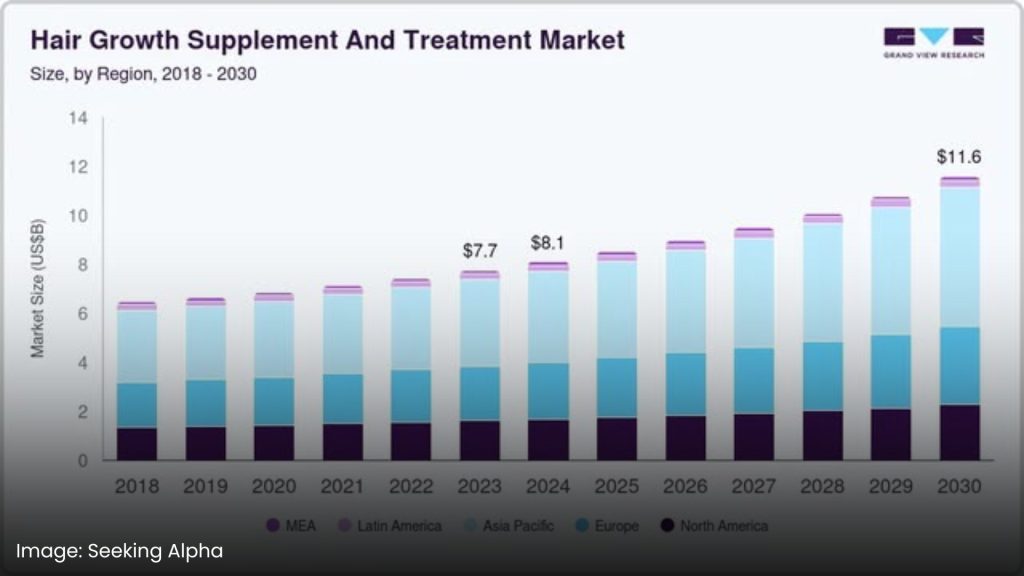
50 million men and 30 million women in the United States experience pattern hair loss. Existing mainstays such as minoxidil and finasteride have been available for decades, while consumers already spend heavily on medications, cosmetic products and procedures.

That combination of enormous demand, limited innovation and established willingness to spend has caught Wall Street’s attention.

Veradermics Turns Hair Loss Into a Wall Street Trade

Perhaps the clearest example is Veradermics.

The biotech company went public in February at $17 per share. By July, shares had traded above $128, a rise of more than 600% from the IPO price.

The excitement centers on VDPHL01, an extended-release oral formulation of minoxidil being developed specifically for pattern hair loss.

The clinical numbers explain some of the enthusiasm. In a male Phase 2/3 study, the once-daily group recorded an average increase of 30.3 non-vellus hairs per cm² after six months, versus 7.3 for placebo.

Separate Phase 2 data in women found 88.9% of once-daily and 90% of twice-daily participants reported improved or much-improved hair coverage after six months.

But the distinction Wall Street occasionally finds inconvenient remains crucial: VDPHL01 is still experimental.
Eli Lilly Makes a $40 Million AI Hair-Loss Bet

Absci is pursuing something radically different.

Its ABS-201 is an AI-designed antibody targeting the prolactin receptor. Interim Phase 1 data suggested an estimated half-life of at least 65 days, potentially supporting only two or three injections over six months if later studies confirm the findings. Proof-of-concept data are expected as development continues.

Then came the financial signal.

Eli Lilly made a $40 million strategic equity investment in Absci as part of a $100 million offering.

It is serious money. It is not clinical proof.

Cosmo Moves Closer to the Regulatory Finish Line

Cosmo Pharmaceuticals is taking another route with clascoterone 5% topical solution, designed to block androgen receptors locally.

Cosmo has reported positive 12-month Phase 3 efficacy and safety data in men with androgenetic alopecia. The company says patients continuing treatment kept gaining hair through Month 12.

One timeline matters enormously: Cosmo plans its U.S. regulatory filing for early 2027. That is a filing target, not an expected approval date. FDA review would still have to follow.

Pelage Wants to Wake Dormant Follicles

Then there is Pelage Pharmaceuticals.

Its topical candidate PP405 is designed to reactivate dormant hair follicle stem cells, pursuing regeneration rather than simply relying on established approaches to slowing hair loss.

Pelage reported positive Phase 2a results in 2025 and subsequently raised $120 million in Series B financing to advance the program.

The mechanism is intriguing, but PP405 remains experimental and its evidence is earlier-stage than some competing programs.

The Money Is Moving Faster Than the Medicine

That may be the most important part of the entire story.

Hair-loss companies are raising enormous sums. Biotech valuations have surged. Major pharmaceutical capital has entered the field. And researchers are attacking pattern hair loss through oral drugs, topical androgen blockers, AI-designed antibodies and regenerative approaches.

But investors are assigning enormous value before the ultimate clinical and regulatory verdicts arrive.

Veradermics still needs regulatory success. Absci needs convincing efficacy data. Cosmo still needs to file and win approval. Pelage has substantial clinical development ahead.

For patients, this pipeline could eventually represent one of the biggest expansions in pattern hair-loss treatment options in decades.

For Wall Street, the bet has already begun.

The money is moving faster than the medicine.

By Shizza Umer

Sources

Wall Street Is Betting on Baldness. Here’s the Science Behind the Hype

The pharmaceutical industry has already watched one enormous consumer-health market explode. GLP-1 drugs transformed obesity treatment, generated extraordinary demand and turned weight loss into one of pharma’s defining commercial stories.

Now investors are hunting for another condition affecting millions of consumers who may be willing to pay directly for better treatment.

Increasingly, they are looking at hair loss.

50 million men and 30 million women in the United States experience pattern hair loss. Existing mainstays such as minoxidil and finasteride have been available for decades, while consumers already spend heavily on medications, cosmetic products and procedures.

That combination of enormous demand, limited innovation and established willingness to spend has caught Wall Street’s attention.

Veradermics Turns Hair Loss Into a Wall Street Trade

Perhaps the clearest example is Veradermics.

The biotech company went public in February at $17 per share. By July, shares had traded above $128, a rise of more than 600% from the IPO price.

The excitement centers on VDPHL01, an extended-release oral formulation of minoxidil being developed specifically for pattern hair loss.

The clinical numbers explain some of the enthusiasm. In a male Phase 2/3 study, the once-daily group recorded an average increase of 30.3 non-vellus hairs per cm² after six months, versus 7.3 for placebo.

Separate Phase 2 data in women found 88.9% of once-daily and 90% of twice-daily participants reported improved or much-improved hair coverage after six months.

But the distinction Wall Street occasionally finds inconvenient remains crucial: VDPHL01 is still experimental.

Eli Lilly Makes a $40 Million AI Hair-Loss Bet

Absci is pursuing something radically different.

Its ABS-201 is an AI-designed antibody targeting the prolactin receptor. Interim Phase 1 data suggested an estimated half-life of at least 65 days, potentially supporting only two or three injections over six months if later studies confirm the findings. Proof-of-concept data are expected as development continues.

Then came the financial signal.

Eli Lilly made a $40 million strategic equity investment in Absci as part of a $100 million offering.

It is serious money. It is not clinical proof.

Cosmo Moves Closer to the Regulatory Finish Line

Cosmo Pharmaceuticals is taking another route with clascoterone 5% topical solution, designed to block androgen receptors locally.

Cosmo has reported positive 12-month Phase 3 efficacy and safety data in men with androgenetic alopecia. The company says patients continuing treatment kept gaining hair through Month 12.

One timeline matters enormously: Cosmo plans its U.S. regulatory filing for early 2027. That is a filing target, not an expected approval date. FDA review would still have to follow.

Pelage Wants to Wake Dormant Follicles

Then there is Pelage Pharmaceuticals.

Its topical candidate PP405 is designed to reactivate dormant hair follicle stem cells, pursuing regeneration rather than simply relying on established approaches to slowing hair loss.

Pelage reported positive Phase 2a results in 2025 and subsequently raised $120 million in Series B financing to advance the program.

The mechanism is intriguing, but PP405 remains experimental and its evidence is earlier-stage than some competing programs.

The Money Is Moving Faster Than the Medicine

That may be the most important part of the entire story.

Hair-loss companies are raising enormous sums. Biotech valuations have surged. Major pharmaceutical capital has entered the field. And researchers are attacking pattern hair loss through oral drugs, topical androgen blockers, AI-designed antibodies and regenerative approaches.

But investors are assigning enormous value before the ultimate clinical and regulatory verdicts arrive.

Veradermics still needs regulatory success. Absci needs convincing efficacy data. Cosmo still needs to file and win approval. Pelage has substantial clinical development ahead.

For patients, this pipeline could eventually represent one of the biggest expansions in pattern hair-loss treatment options in decades.

For Wall Street, the bet has already begun.

The money is moving faster than the medicine.

By Shizza Umer

Sources

spot_img

Explore more

spot_img
Global Affairs

Britain Bans Settlement Goods. Isr*el Retaliates Immediately.

Jews then. Muslims now? Germany’s far right is rising again.

Lindsay Clancy’s Trial Ends in Mistrial. Then Two More Mothers Face...

THE UN JUST ADMITTED THE 1.5°C PROMISE IS BROKEN

Mark Ruffalo’s Hollywood Showdown

WHO CONTROLS THE INDUS? THE HAGUE AND INDIA ARE NOW IN...

Two News Crews. Four Days. Both Att∗acked By Isr∗eli Settlers.

THE RSS TAKES MADISON SQUARE GARDEN