
Half the World Is Drowning in Debt and Nobody Is Even Telling the Truth About Where the Money Goes.

Governments Are Borrowing in Secret, Spending on Debt Instead of Children, and Nobody Is Being Asked to Explain Why

Isla Montclair

Blsh

Almost half the world’s population lives in countries that pay more on debt interest than on education or health. New data shows 50% of those same governments do not publish basic information about what they owe or why. This is an analytical piece about what that combination actually means and who it serves.

Start With What Is Happening to Children

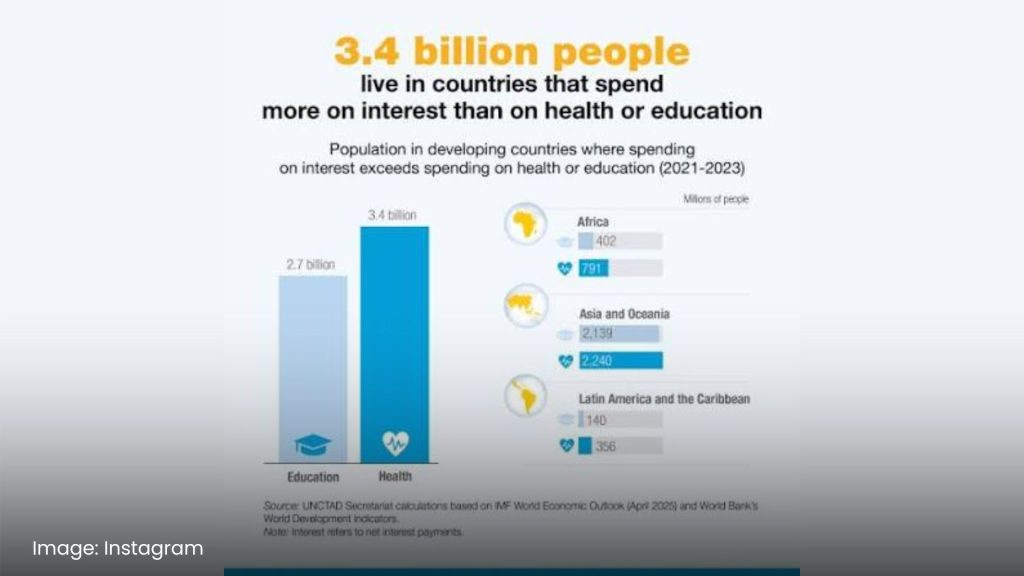
The numbers that frame this story are not abstract. Almost half of the world’s population now lives in countries that spend more money paying interest on their debts than on education or health. This is not a historical footnote or a projection. It is the current reality for billions of people, documented in new data published this week as UN officials and government leaders gather in New York for the High-level Political Forum to review SDG 17, the global goal covering financing and international partnership.

The cost of borrowing for African countries in particular rose 91% since 2020. In 2024, the 10 countries facing the worst barriers to girls’ education spent, on average, four times more on debt servicing than on education. The World Bank estimates that today’s children could lose up to half of their future lifetime earnings because of deficits in learning and human capital development caused by the spending choices that debt forces governments to make.
These are not the consequences of bad luck or poor weather. They are the consequences of a specific set of financial decisions made by governments, enabled by lenders, and hidden from the populations that live with the results.

The Opacity That Nobody Talks About

Work by the International Budget Partnership shows that the global debt crisis is also an accountability crisis. The Open Budget Survey 2025 finds that 50% of surveyed countries do not provide information on the composition of debt in their budget proposals, and just 18% publish any information on the sustainability of government finances over the next ten years.

40% of low-income countries have not published any data about their sovereign debt for more than two years. In a recent assessment of 11 African countries, only one published a borrowing plan connected to the annual budget cycle and linked borrowing to specific sectors or projects. In all 11 countries, parliaments approve borrowing without access to comprehensive information on how those funds will be used or what development outcomes they are expected to deliver.

Read those sentences again slowly. Parliaments, the bodies whose constitutional function is to authorise and scrutinise public spending, are approving loans without knowing what those loans are for. The populations who will spend decades repaying those loans have no legal right to know what they financed. The schools that were not built, the hospitals that were not staffed, the girls who were pulled out of classrooms: these are the downstream consequences of borrowing decisions made in rooms that oversight bodies and citizens are not allowed to enter.

Publicly available tallies of debt stocks in low-income countries can vary by as much as 30% of a country’s GDP because of divergent definitions and standards in local and international databases. This is not a rounding error. A 30% GDP discrepancy in debt figures means nobody, not lenders, not parliaments, not citizens, actually knows the real size of the problem they are managing.


Why the Opacity Is Not an Accident

Sovereign debt crises are often the product of a deliberately created ecosystem where domestic elites and external actors collude to generate unsustainable debt for private gain.

This is the sentence that the polite language of development finance never quite says out loud but that the evidence consistently points toward. When a government borrows billions without telling its parliament what the money is for, and without publishing the loan terms, and without connecting the borrowing to any specific development outcome, the absence of information is not an oversight. It is a feature. It protects the people making the decisions from scrutiny by the people living with the consequences.

In many developing nations, traditional anti-corruption strategies assume a rule-following environment that does not exist. Instead, actors are embedded in dense networks of informal negotiations where rule-breaking is the rational choice for those in power. When a multi-billion-dollar infrastructure project is on the table, the incentives for kickbacks are so high that insiders can easily manufacture plausible justifications for inflated costs. External monitors, no matter how transparent the data, often lack the technical capability or political muscle to challenge these sophisticated narratives.

The World Bank has documented that in past crises it became apparent that borrowed funds had been diverted to purposes that did not raise export proceeds, productivity or potential output. Hidden debts have repeatedly surfaced only after economies were already in crisis, when the damage was irreversible and the people responsible were no longer in office.

The world too often learns of unsustainable debt burdens when economies are already in free fall. Several countries regained access to international capital markets in recent years, only for hidden debts to surface and send them into crisis.

What Transparency Actually Requires

Sovereigns that proactively disclose debt data paired with credible fiscal plans are better positioned to maintain market access and navigate turbulent periods. By contrast, opacity can prove costly.

The IMF and World Bank have both called for what they term radical debt transparency: publishing loan terms and payment schedules, fully disclosing public and publicly traded debt including the liabilities of state-owned enterprises, removing confidentiality clauses that prevent transparent reporting, and promoting prudent use of collateral in sovereign borrowing.

These are not technically difficult requirements. They are politically inconvenient ones. Publishing loan terms exposes what was negotiated and by whom. Disclosing state enterprise liabilities reveals what is owed off-budget. Removing confidentiality clauses ends the practice of hiding unfavourable terms from domestic oversight bodies.

The SDG bond of the Government of Benin has shown that debt instruments linked to social outcomes and public reporting are already working in practice. Debt is not inherently incompatible with development, but it must be borrowed transparently, invested productively and subjected to public scrutiny. Those three conditions are currently missing in the majority of the countries that need them most.

The Question the Forum in New York Has to Answer

This week’s High-level Political Forum in New York exists precisely to review whether the global financing and partnership goals are being met. The honest answer, based on the evidence, is no. Not because the goals were wrong, but because the accountability architecture required to achieve them was never built.
Debt crises will continue to recur if governments continue to borrow without telling oversight bodies or the public how they are borrowing, why or on what terms. When decisions with lifelong consequences are made behind closed doors, children inevitably lose first, and longest.

The opacity in sovereign debt is not a technical problem awaiting a technical solution. It is a political problem that serves identifiable interests. Naming those interests clearly, building legal frameworks that mandate disclosure, and giving parliaments and civil society the tools to actually read and challenge what they are shown is the work that the Forum needs to commit to. Whether it will is a different question entirely.

Sources:

·  We Owe Future Generations a Path Out of the Global Debt Crisis, Inter Press Service: https://www.ipsnews.net/2026/07/we-owe-future-generations-a-path-out-of-the-global-debt-crisis/

·  Beyond transparency: a better model for sovereign debt crises, Asia Times: https://asiatimes.com/2026/06/beyond-transparency-a-better-model-for-sovereign-debt-crises/

·  Debt Transparency in Developing Economies, World Bank: https://documents1.worldbank.org/curated/en/743881635526394087/pdf/Debt-Transparency-in-Developing-Economies.pdf

·  The World Needs Radical Debt Transparency, World Bank Blogs: https://blogs.worldbank.org/en/voices/the-world-needs-radical-debt-transparency

·  Strengthening Sovereign-Debt Transparency in a Time of Growing Vulnerabilities, International Banker: https://internationalbanker.com/finance/strengthening-sovereign-debt-transparency-in-a-time-of-growing-vulnerabilities/


Governments Are Borrowing in Secret, Spending on Debt Instead of Children, and Nobody Is Being Asked to Explain Why

Isla Montclair

Blsh

Almost half the world’s population lives in countries that pay more on debt interest than on education or health. New data shows 50% of those same governments do not publish basic information about what they owe or why. This is an analytical piece about what that combination actually means and who it serves.

Start With What Is Happening to Children

The numbers that frame this story are not abstract. Almost half of the world’s population now lives in countries that spend more money paying interest on their debts than on education or health. This is not a historical footnote or a projection. It is the current reality for billions of people, documented in new data published this week as UN officials and government leaders gather in New York for the High-level Political Forum to review SDG 17, the global goal covering financing and international partnership.

The cost of borrowing for African countries in particular rose 91% since 2020. In 2024, the 10 countries facing the worst barriers to girls’ education spent, on average, four times more on debt servicing than on education. The World Bank estimates that today’s children could lose up to half of their future lifetime earnings because of deficits in learning and human capital development caused by the spending choices that debt forces governments to make.

These are not the consequences of bad luck or poor weather. They are the consequences of a specific set of financial decisions made by governments, enabled by lenders, and hidden from the populations that live with the results.

The Opacity That Nobody Talks About

Work by the International Budget Partnership shows that the global debt crisis is also an accountability crisis. The Open Budget Survey 2025 finds that 50% of surveyed countries do not provide information on the composition of debt in their budget proposals, and just 18% publish any information on the sustainability of government finances over the next ten years.

40% of low-income countries have not published any data about their sovereign debt for more than two years. In a recent assessment of 11 African countries, only one published a borrowing plan connected to the annual budget cycle and linked borrowing to specific sectors or projects. In all 11 countries, parliaments approve borrowing without access to comprehensive information on how those funds will be used or what development outcomes they are expected to deliver.

Read those sentences again slowly. Parliaments, the bodies whose constitutional function is to authorise and scrutinise public spending, are approving loans without knowing what those loans are for. The populations who will spend decades repaying those loans have no legal right to know what they financed. The schools that were not built, the hospitals that were not staffed, the girls who were pulled out of classrooms: these are the downstream consequences of borrowing decisions made in rooms that oversight bodies and citizens are not allowed to enter.

Publicly available tallies of debt stocks in low-income countries can vary by as much as 30% of a country’s GDP because of divergent definitions and standards in local and international databases. This is not a rounding error. A 30% GDP discrepancy in debt figures means nobody, not lenders, not parliaments, not citizens, actually knows the real size of the problem they are managing.

Why the Opacity Is Not an Accident

Sovereign debt crises are often the product of a deliberately created ecosystem where domestic elites and external actors collude to generate unsustainable debt for private gain.

This is the sentence that the polite language of development finance never quite says out loud but that the evidence consistently points toward. When a government borrows billions without telling its parliament what the money is for, and without publishing the loan terms, and without connecting the borrowing to any specific development outcome, the absence of information is not an oversight. It is a feature. It protects the people making the decisions from scrutiny by the people living with the consequences.

In many developing nations, traditional anti-corruption strategies assume a rule-following environment that does not exist. Instead, actors are embedded in dense networks of informal negotiations where rule-breaking is the rational choice for those in power. When a multi-billion-dollar infrastructure project is on the table, the incentives for kickbacks are so high that insiders can easily manufacture plausible justifications for inflated costs. External monitors, no matter how transparent the data, often lack the technical capability or political muscle to challenge these sophisticated narratives.

The World Bank has documented that in past crises it became apparent that borrowed funds had been diverted to purposes that did not raise export proceeds, productivity or potential output. Hidden debts have repeatedly surfaced only after economies were already in crisis, when the damage was irreversible and the people responsible were no longer in office.

The world too often learns of unsustainable debt burdens when economies are already in free fall. Several countries regained access to international capital markets in recent years, only for hidden debts to surface and send them into crisis.

What Transparency Actually Requires

Sovereigns that proactively disclose debt data paired with credible fiscal plans are better positioned to maintain market access and navigate turbulent periods. By contrast, opacity can prove costly.

The IMF and World Bank have both called for what they term radical debt transparency: publishing loan terms and payment schedules, fully disclosing public and publicly traded debt including the liabilities of state-owned enterprises, removing confidentiality clauses that prevent transparent reporting, and promoting prudent use of collateral in sovereign borrowing.

These are not technically difficult requirements. They are politically inconvenient ones. Publishing loan terms exposes what was negotiated and by whom. Disclosing state enterprise liabilities reveals what is owed off-budget. Removing confidentiality clauses ends the practice of hiding unfavourable terms from domestic oversight bodies.

The SDG bond of the Government of Benin has shown that debt instruments linked to social outcomes and public reporting are already working in practice. Debt is not inherently incompatible with development, but it must be borrowed transparently, invested productively and subjected to public scrutiny. Those three conditions are currently missing in the majority of the countries that need them most.

The Question the Forum in New York Has to Answer

This week’s High-level Political Forum in New York exists precisely to review whether the global financing and partnership goals are being met. The honest answer, based on the evidence, is no. Not because the goals were wrong, but because the accountability architecture required to achieve them was never built.

Debt crises will continue to recur if governments continue to borrow without telling oversight bodies or the public how they are borrowing, why or on what terms. When decisions with lifelong consequences are made behind closed doors, children inevitably lose first, and longest.

The opacity in sovereign debt is not a technical problem awaiting a technical solution. It is a political problem that serves identifiable interests. Naming those interests clearly, building legal frameworks that mandate disclosure, and giving parliaments and civil society the tools to actually read and challenge what they are shown is the work that the Forum needs to commit to. Whether it will is a different question entirely.

Sources:

·  We Owe Future Generations a Path Out of the Global Debt Crisis, Inter Press Service: https://www.ipsnews.net/2026/07/we-owe-future-generations-a-path-out-of-the-global-debt-crisis/

·  Beyond transparency: a better model for sovereign debt crises, Asia Times: https://asiatimes.com/2026/06/beyond-transparency-a-better-model-for-sovereign-debt-crises/

·  Debt Transparency in Developing Economies, World Bank: https://documents1.worldbank.org/curated/en/743881635526394087/pdf/Debt-Transparency-in-Developing-Economies.pdf

·  The World Needs Radical Debt Transparency, World Bank Blogs: https://blogs.worldbank.org/en/voices/the-world-needs-radical-debt-transparency

·  Strengthening Sovereign-Debt Transparency in a Time of Growing Vulnerabilities, International Banker: https://internationalbanker.com/finance/strengthening-sovereign-debt-transparency-in-a-time-of-growing-vulnerabilities/

spot_img

Explore more

spot_img
Global Affairs

UN Official Calls West Bank Attacks “Pogroms,” Wants Weapons Ban on...

UN Rights Chief Wins Second Term, But the US, Israel and...

A Super El Nino Could Cost the World Up to 7...

Trump to Use Frozen Iranian Money, Worth Billions, to Pay for...

Iran Rejects New US Ceasefire Offer, Says It Rejected a Broken...

Houthis Strike Two Saudi Oil Tankers, Block Red Sea as Oil...

UK Mosques Attacked Every 5 Days, But One Boy Is Fighting...