
The 2026 World Cup’s Real Price Tag: Billions Lost Before a Ball Was Even in Play

The Economic Cost of the 2026 World Cup: What the Data Actually Shows

Maryam Tariq

The 2026 FIFA World Cup delivered record viewership and a genuinely historic 48 team format spread across the United States, Canada and Mexico. It also delivered a measurable economic drag that had nothing to do with stadium construction or ticket prices, lost workplace productivity, tracked through both employee surveys and real building attendance data.

The Headline Productivity Numbers

Workforce management company UKG surveyed 8,000 employees across Australia, Canada, France, Germany, Mexico, the Netherlands, the UK and the US ahead of the tournament, estimating it could drive at least 17 billion dollars in lost productivity globally, including 11.7 billion dollars in the US alone. The US share reflects a simple scheduling reality, many matches fell during normal American working hours, unlike in European time zones where evening kickoffs caused less direct workday disruption. UKG’s Chief Product Officer Suresh Vittal described the tournament as a real workforce planning test that can strain performance, productivity, communication, and even retention if not proactively managed.

What Employees Actually Said They’d Do

The survey went beyond a single headline figure. Thirty seven percent of employees globally said they planned to adjust their work schedule specifically because of the tournament, and 27 percent expected to miss work outright, through late arrivals, early departures or full days off. More striking were the smaller but sharper numbers, 26 percent admitted they’d push the limits of what their employer would tolerate, including 14 percent who planned to secretly stream matches while on the clock. Twenty two percent expected to show up to work exhausted, and 11 percent admitted they’d be working while hungover. Nearly 40 percent of employees said they didn’t believe their employer would even care about the tournament, and 19 percent said they’d consider looking for another job if their employer restricted their World Cup viewing.
Real Building Data Confirms the Pattern

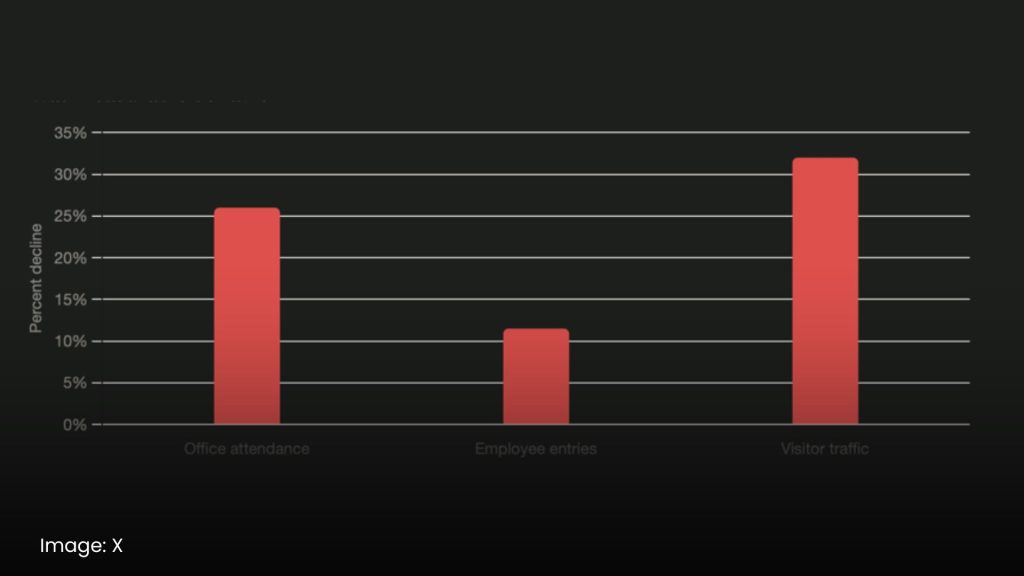
This wasn’t just self reported intent. Workplace platform Envoy tracked real office attendance data during the tournament and found the sharpest disruption came the day after the US men’s national team was eliminated. Office attendance dropped 26 percent that day, employee building entries fell 11.5 percent, and visitor traffic, covering client meetings, interviews and vendor appointments, dropped 32 percent, suggesting companies postponed meetings rather than closing offices outright. Envoy noted this attendance dip was nearly ten times larger than the drop the company had observed following the Super Bowl earlier in the year.

Which Cities Carried the Heaviest Exposure

A separate modeling exercise from outplacement firm Challenger, Gray & Christmas estimated potential city level exposure across host markets. Their scenario modeling found that if all employed soccer fans in host cities took a single day off to watch a major match, New York and New Jersey faced the highest potential exposure at 2.14 billion dollars, followed by Los Angeles at 1.26 billion dollars and Dallas at roughly 747.59 million dollars. It’s worth noting this is a hypothetical modeling exercise built around worst case assumptions, not a measured outcome, but it illustrates where workforce density made cities most vulnerable to disruption.
The Other Side of the Ledger

None of these productivity figures account for what host cities gained. Hotels, restaurants, transit systems and retailers saw a genuine influx of spending from international visitors during the tournament. But economists studying past World Cups and Olympics have consistently found that these headline tourism boosts tend to be smaller in practice than initial projections suggest, partly because regular tourism gets displaced by sports fans rather than simply added to it, and partly because a significant share of tournament related revenue is captured by FIFA itself rather than local businesses.

What This Means Going Forward

Taken together, the data paints a clearer picture than either side of the debate usually offers. The productivity losses were real, measurable, and concentrated in specific cities and time windows tied directly to match schedules. Whether that cost was offset by tourism and long term soft power gains remains a genuinely open economic question, one that will likely take years, not weeks, to actually settle.

Sources:

·  World Cup Could Cost Employers $17 Billion in Lost Productivity, UKG Says — UKG Newsroom: https://www.ukg.com/company/newsroom/world-cup-could-cost-employers-17-billion-lost-productivity-ukg-says

·  FIFA World Cup Led To Major Productivity Losses In U.S., Report Says — indica News: https://indicanews.com/fifa-world-cup-led-to-major-productivity-losses-in-u-s-report-says/

·  FIFA World Cup: US workplaces lose up to $11.7 billion in productivity — India Tribune Chicago: https://www.indiatribune.com/fifa-world-cup-us-workplaces-lose-up-to-117-billion-in-productivity

·  2026 FIFA World Cup Fever Could Trigger A $30 Billion Productivity Hit For US Employers — Yahoo Finance / Benzinga: https://finance.yahoo.com/economy/articles/2026-fifa-world-cup-fever-100008072.html
The Economic Cost of the 2026 World Cup: What the Data Actually Shows

Maryam Tariq

The 2026 FIFA World Cup delivered record viewership and a genuinely historic 48 team format spread across the United States, Canada and Mexico. It also delivered a measurable economic drag that had nothing to do with stadium construction or ticket prices, lost workplace productivity, tracked through both employee surveys and real building attendance data.

The Headline Productivity Numbers

Workforce management company UKG surveyed 8,000 employees across Australia, Canada, France, Germany, Mexico, the Netherlands, the UK and the US ahead of the tournament, estimating it could drive at least 17 billion dollars in lost productivity globally, including 11.7 billion dollars in the US alone. The US share reflects a simple scheduling reality, many matches fell during normal American working hours, unlike in European time zones where evening kickoffs caused less direct workday disruption. UKG’s Chief Product Officer Suresh Vittal described the tournament as a real workforce planning test that can strain performance, productivity, communication, and even retention if not proactively managed.

What Employees Actually Said They’d Do

The survey went beyond a single headline figure. Thirty seven percent of employees globally said they planned to adjust their work schedule specifically because of the tournament, and 27 percent expected to miss work outright, through late arrivals, early departures or full days off. More striking were the smaller but sharper numbers, 26 percent admitted they’d push the limits of what their employer would tolerate, including 14 percent who planned to secretly stream matches while on the clock. Twenty two percent expected to show up to work exhausted, and 11 percent admitted they’d be working while hungover. Nearly 40 percent of employees said they didn’t believe their employer would even care about the tournament, and 19 percent said they’d consider looking for another job if their employer restricted their World Cup viewing.

Real Building Data Confirms the Pattern

This wasn’t just self reported intent. Workplace platform Envoy tracked real office attendance data during the tournament and found the sharpest disruption came the day after the US men’s national team was eliminated. Office attendance dropped 26 percent that day, employee building entries fell 11.5 percent, and visitor traffic, covering client meetings, interviews and vendor appointments, dropped 32 percent, suggesting companies postponed meetings rather than closing offices outright. Envoy noted this attendance dip was nearly ten times larger than the drop the company had observed following the Super Bowl earlier in the year.

Which Cities Carried the Heaviest Exposure

A separate modeling exercise from outplacement firm Challenger, Gray & Christmas estimated potential city level exposure across host markets. Their scenario modeling found that if all employed soccer fans in host cities took a single day off to watch a major match, New York and New Jersey faced the highest potential exposure at 2.14 billion dollars, followed by Los Angeles at 1.26 billion dollars and Dallas at roughly 747.59 million dollars. It’s worth noting this is a hypothetical modeling exercise built around worst case assumptions, not a measured outcome, but it illustrates where workforce density made cities most vulnerable to disruption.

The Other Side of the Ledger

None of these productivity figures account for what host cities gained. Hotels, restaurants, transit systems and retailers saw a genuine influx of spending from international visitors during the tournament. But economists studying past World Cups and Olympics have consistently found that these headline tourism boosts tend to be smaller in practice than initial projections suggest, partly because regular tourism gets displaced by sports fans rather than simply added to it, and partly because a significant share of tournament related revenue is captured by FIFA itself rather than local businesses.

What This Means Going Forward

Taken together, the data paints a clearer picture than either side of the debate usually offers. The productivity losses were real, measurable, and concentrated in specific cities and time windows tied directly to match schedules. Whether that cost was offset by tourism and long term soft power gains remains a genuinely open economic question, one that will likely take years, not weeks, to actually settle.

Sources:

·  World Cup Could Cost Employers $17 Billion in Lost Productivity, UKG Says — UKG Newsroom: https://www.ukg.com/company/newsroom/world-cup-could-cost-employers-17-billion-lost-productivity-ukg-says

·  FIFA World Cup Led To Major Productivity Losses In U.S., Report Says — indica News: https://indicanews.com/fifa-world-cup-led-to-major-productivity-losses-in-u-s-report-says/

·  FIFA World Cup: US workplaces lose up to $11.7 billion in productivity — India Tribune Chicago: https://www.indiatribune.com/fifa-world-cup-us-workplaces-lose-up-to-117-billion-in-productivity

·  2026 FIFA World Cup Fever Could Trigger A $30 Billion Productivity Hit For US Employers — Yahoo Finance / Benzinga: https://finance.yahoo.com/economy/articles/2026-fifa-world-cup-fever-100008072.html
spot_img

Explore more

spot_img
Global Affairs

“Jihadist” Talk From Trump Isn’t Just Offensive, It’s Putting Muslim Officials...

Netanyahu Rejects Trump’s Gaza Peace Plan, Continuing a Pattern of Defying...

US to Tariff India 100% Over Russian Oil, but Four Years...

How Media Language Quietly Whitewashes Israel’s War in Gaza

Lebanon’s Crisis Didn’t End With the Ceasefire, and Its Rescue Fund...

Reform UK and Restore Britain May Team Up, Here’s What That...

How One Amateur Astronomer Predicted a Rocket Would Hit the Moon,...