How a local dispute became a regional crisis
On 26 July, a Hindu Bol Bam procession passed through Kaptanganj in Sunsari district, close to Nepal’s open border with India. Tensions had reportedly already developed after a Muslim community flag on a utility pole was replaced by a Hindu flag. A dispute over loud devotional music then escalated into stone-throwing between members of both communities.
As security forces tried to disperse the crowds, they fired warning shots and then live ammunition. 24-year-old Om Prakash Mehta was killed during the original confrontation. 20-year-old Jaya Prakash Mehta later died from injuries sustained during the same unrest. 17-year-old Ganesh Yadav was subsequently shot in the neck by security personnel during protests in Golbazar, Siraha.
The most important correction is therefore also the one most frequently obscured: all three confirmed fatalities were Hindu men killed by security-force gunfire, not Muslim attackers. The toll stood at three dead and 25 injured, with curfews imposed across several towns.
How anger was redirected towards Muslims
The deaths intensified Hindu anger, but the outrage did not remain focused on the police and armed security forces responsible for the fatal shootings. Muslim residents, businesses and religious sites increasingly became targets.
A Muslim-owned repair shop in Sunsari was burned while a crowd chanted “Jai Shri Ram”, and a historic mosque in Koshi Rural Municipality was vandalised, with attackers accused of burning Qurans and assaulting an elderly Muslim couple inside. A mosque in Golbazar, Siraha was targeted and partly set on fire during a Hindu nationalist protest. A Muslim man was assaulted in front of police in Kasaha, Siraha, before officers intervened.
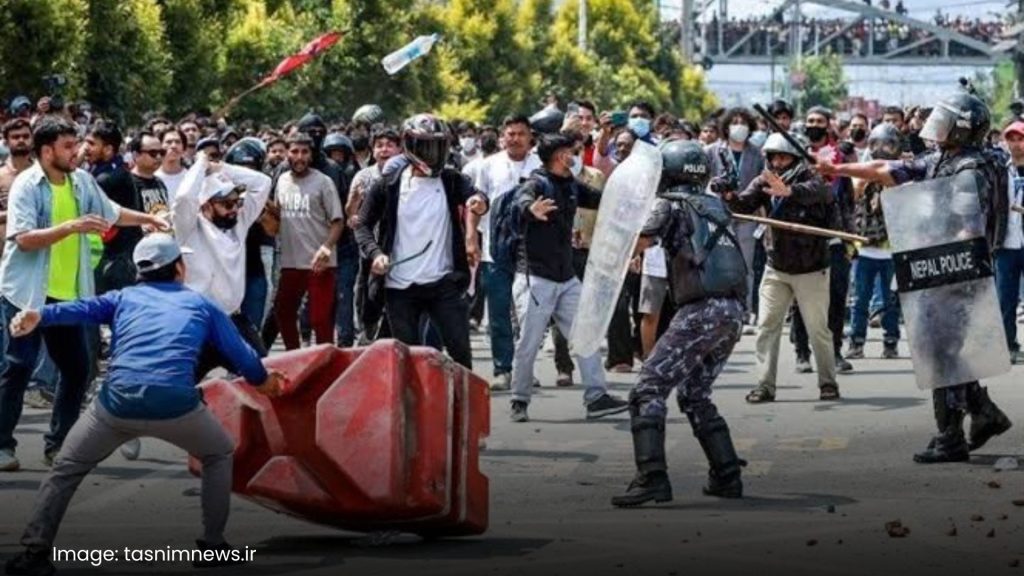
Individual claims still require investigation and careful visual authentication, particularly because Nepal Police warned that unrelated and recycled footage was being circulated online.
What is beyond serious dispute is that the crisis expanded well past the original confrontation. Mass arson and vandalism spread, mobs threatened people identified with another religion, and misinformation falsely claimed Rohingya refugees or Muslims arriving from India were responsible for the unrest.
The Hindutva question
Nepal’s violence did not emerge in a political vacuum. Hindu nationalist organisations have become increasingly visible in the southern border regions, while monarchist and religious movements are campaigning to reverse Nepal’s secular constitutional order and restore the country as a Hindu state.
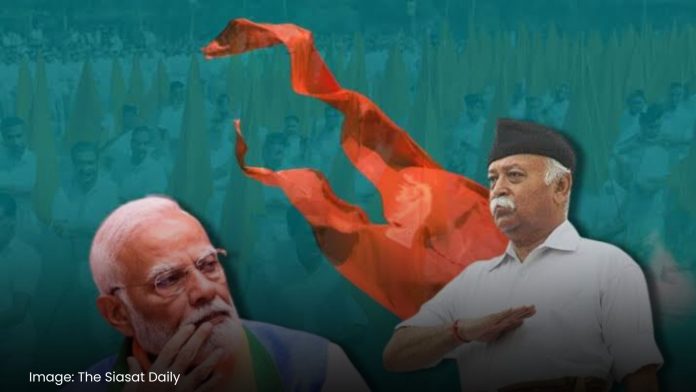
Birgunj’s mayor publicly acknowledged travelling with ward representatives to Maharashtra to meet RSS chief Mohan Bhagwat, and civil-society observers linked the period after that meeting with a visible increase in organised Hindu nationalist rallies in the city. The same reporting noted an active presence by RSS-linked organisations, including the Vishwa Hindu Parishad and Bajrang Dal, in Nepali border towns.
This does not prove the RSS organised the violence in Sunsari or Siraha. No publicly available evidence currently establishes such a chain of command. But direct orders are not the only way an ideology travels. Religious processions, slogans, political relationships, social-media networks and narratives presenting Muslims as a threat can all reshape the environment in which local disputes become communal crises.
Nepal’s secular future is now being tested
The government has promised a fair investigation, while political leaders and civil-society groups have organised peace and unity initiatives.
But calm is not the same as accountability.
Nepal must investigate the use of live ammunition, the people who organised or participated in retaliatory attacks, the role of misinformation, and whether political networks protected or encouraged those responsible.
The evidence does not yet prove that India’s RSS directed the unrest. It does establish a more urgent question: whether the anti-Muslim Hindutva politics that transformed communal relations across India is now finding deeper political and organisational roots inside Nepal.
By Shizza Umer
Sources
The Kathmandu Post — “Why Nepal’s communal tensions keep returning”
The Kathmandu Post — “Past incidents show political, social engagements quell communal strife”
The Kathmandu Post — “RSP chief Lamichhane’s lead helped government douse eastern Tarai flames”