India Freed Two Kashmiri Rights Defenders. Kashmir Is Still Off Limits.
They Spent A Combined 2,922 Days In Prison Without Trial
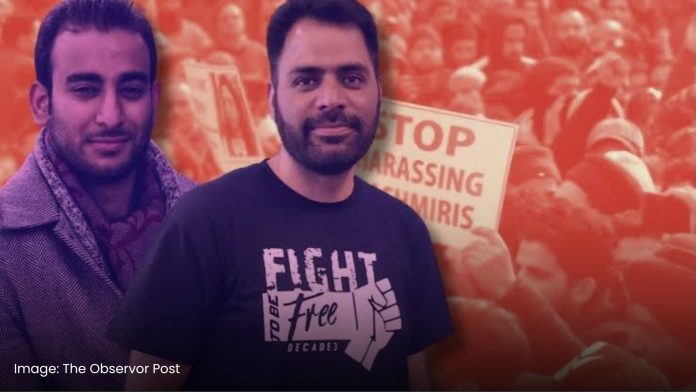
Kashmiri human rights defender Khurram Parvez and journalist Irfan Mehraj walked out of Rohini Jail in New Delhi late on 22 July 2026.
Parvez had spent 1,703 days in detention. Mehraj had spent 1,219. Together, they lost 2,922 days behind bars while their anti-terror prosecution remained unresolved, in a case the NIA originally registered back in October 2020, before either man was even arrested.
A New Delhi trial court granted them bail on 18 July. India’s National Investigation Agency filed two separate appeals within two days, one against each man, and had both urgently listed and heard by the Delhi High Court on 20 July. The High Court refused to stay their release on 22 July but imposed stricter conditions while the appeal proceeds.
They have not been acquitted. The allegations remain active, and the NIA’s challenge is scheduled to be heard again later in August.
They Documented Kashmir’s Disappeared, Tortured And Dead
Parvez is the programme coordinator of the Jammu Kashmir Coalition of Civil Society, an organisation that has documented alleged torture, unlawful killings, enforced disappearances and unmarked graves in Indian administered Kashmir.
Mehraj is an independent journalist and researcher who worked with the coalition and reported on surveillance, state policy, conflict and alleged human rights abuses.
The National Investigation Agency alleges that the organisation operated as a front for separatist and militant linked activity, received foreign funding and supported prohibited groups. Parvez and Mehraj deny the charges.
Their supporters argue that India has transformed human rights documentation, international advocacy and assistance to conflict affected families into evidence of terrorism.
The United Nations Working Group on Arbitrary Detention concluded in 2023 that Parvez’s detention was arbitrary and retaliatory. It called for his immediate and unconditional release.
Parvez Had Already Been Silenced Before
This was not Parvez’s first confrontation with Indian authorities, and it is not the only restriction on his voice right now.
In 2016, officials stopped him from travelling to Geneva, where he was expected to attend a United Nations Human Rights Council session. He was arrested the following day and detained for 76 days before a court ruled that detention illegal.
Five years later, the National Investigation Agency arrested him at his Srinagar home on 22 November 2021, in a separate case. In a bail granted for that case on 10 June 2026, the Delhi High Court barred him from making public statements as one of 13 conditions, alongside a bond of 600,000 INR and mandatory residence in Delhi.
Mehraj was arrested in this week’s case in March 2023, after investigators called him to their Srinagar office. His family said he had been told the questioning would take only a few minutes.
Both men were transferred to New Delhi, approximately 900 kilometres from their homes in Kashmir.
Their case forms part of a wider crackdown on Kashmiri journalists, researchers, lawyers and civil society groups since India revoked Jammu and Kashmir’s special constitutional status in 2019.
Bail Did Not Restore Their Freedom
Under the conditions of this week’s release, Parvez and Mehraj must remain in Delhi unless a court grants permission to travel. They have surrendered their passports.
They must report in person to the NIA’s investigating officer twice every week, and are barred from contacting anyone named in the case’s chargesheet or engaging in activity connected to it.
That leaves as little as three or four days between reporting visits, barely enough time to reach Srinagar and return even if travel were permitted.
A rights defender who spent years imprisoned over allegations connected to his documentation work is now outside prison but still separated from the region, the organisation and, in his other case, the public voice that made him a target in the first place.
Release Is Not Justice
The International Federation for Human Rights and the World Organisation Against Torture welcomed the bail decision but called on India to drop the charges completely.
That distinction matters.
Bail ends detention while a prosecution continues. It does not return the years taken from either man, clear their names or prevent the National Investigation Agency from seeking to send them back to prison.
Parvez and Mehraj are no longer behind bars.
But they remain confined to Delhi, separated from Kashmir, and still reporting twice a week to the agency that held them for years.
India released them from prison.
It has not fully returned their freedom.
Hyperlinked Sources
Al Jazeera: Kashmiri activist Khurram Parvez and journalist Irfan Mehraj freed on bail
FIDH: India: Khurram Parvez and Irfan Mehraj released on bail
The Wire: Khurram Parvez, Irfan Mehraj Given Bail in NIA’s ‘NGO Terror Funding’ Case