
China Returned To The Supercomputer Race At No. 1
Lu Yutong stood at the ISC High Performance 2026 conference in Hamburg and explained what his team had built. LineShine, he said, features specialized circuitry to handle matrix and vector calculations directly on the CPU, allowing it to manage traditional science tasks and AI training simultaneously.
What he did not need to say was the part everyone in the room already understood: China had just built the world’s fastest publicly ranked supercomputer without relying on the American GPU stack Washington has spent years trying to control.
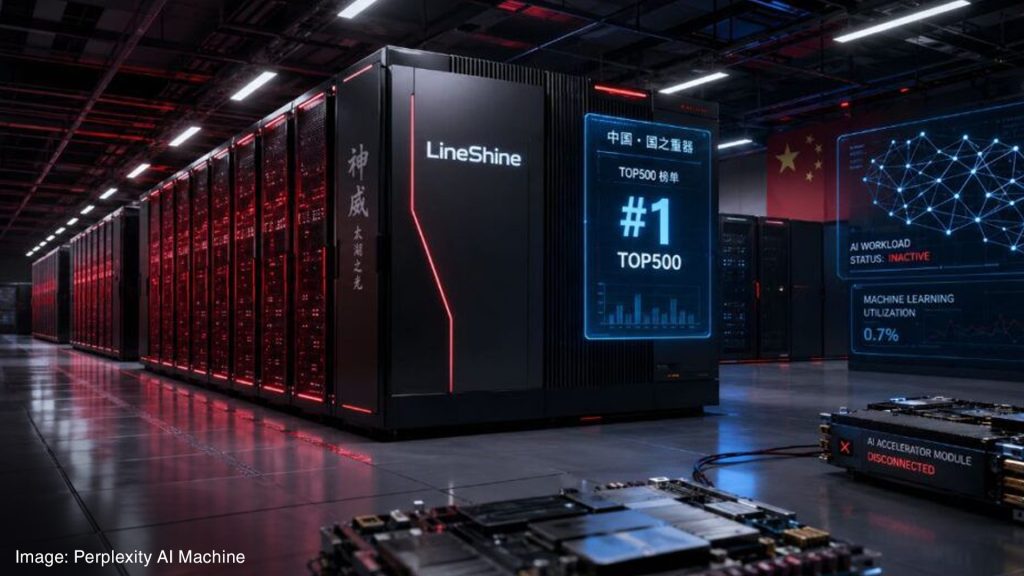
TOP500 reported LineShine reached 2.198 exaflops, while El Capitan reached 1.809 exaflops. That makes China’s new machine roughly 21.5% faster on the benchmark, close enough to say about 20% faster without turning the sentence into a math hostage situation.
The US machine it displaced is housed at Lawrence Livermore National Laboratory and helps maintain America’s nuclear weapons stockpile.
China Built Around The Ban
The political message is bigger than the speed.
LineShine was built on domestic processors and Chinese software, installed at the National Supercomputing Centre in Shenzhen. It uses a CPU-based design rather than the Nvidia-style GPUs that power much of the AI boom.
Tom’s Hardware reported that LineShine is powered by LX2 processors and became the first machine on the TOP500 ranking to sustain more than two exaflops of double-precision performance using only CPUs.
That matters because Washington spent years trying to restrict China’s access to advanced chips. Reuters reported that China disappeared from the TOP500 after those controls tightened in 2023. Then it came back with the world’s fastest publicly ranked supercomputer.
The ban was meant to slow China down. Instead, it helped push Beijing toward building around the wall.
This Is Not The Same As Winning The AI Race
There is one important caveat: LineShine is not proof China now leads the world in AI compute.
Reuters reported that LineShine ranked only fourth on a benchmark designed to mimic more AI-style workloads. Its CPU-based design is powerful for traditional supercomputing, but it lacks the GPU-heavy architecture used by the biggest private AI clusters.
If Amazon, Microsoft and Google submitted their systems, LineShine would not crack the top five.
So the story is not “China beat America in AI.”
The story is sharper than that: China used the chips Washington did not fully block, scaled them massively, and took the supercomputer crown anyway.
The Chip War Just Changed Shape
Jack Dongarra, an emeritus professor of computer science at the University of Tennessee and one of the organisers of the TOP500 list, put it plainly: “Export controls may slow China’s access to certain advanced components, but they also provide a strong incentive to develop domestic alternatives. In the longer term, controls may both constrain China and accelerate its efforts to become technologically self-sufficient.”
That is the danger inside sanctions policy. Export controls can slow a rival. But they can also force that rival to become more independent. China did not just find a workaround. It built a machine that Washington cannot simply switch off by blocking one foreign supplier.
As The Next Web reported: “China assembled the fastest machine on Earth, deliberately, from everything America tried to keep out.”
That sentence is the story.
LineShine is not only a supercomputer. It is a signal that the US-China tech war is moving into a new phase: less dependence, more domestic stacks, and fewer easy levers for Washington to pull.
By Verity Quill | verumnetwork.com
Sources