For most of modern history, flying cars belonged to imagination. They existed in futuristic films, in sketches of tomorrow’s cities, and in the collective belief that one day traffic would move from roads to skies. For decades, that future never quite arrived.
Now, it is beginning to take shape, not as fantasy, but as engineering.
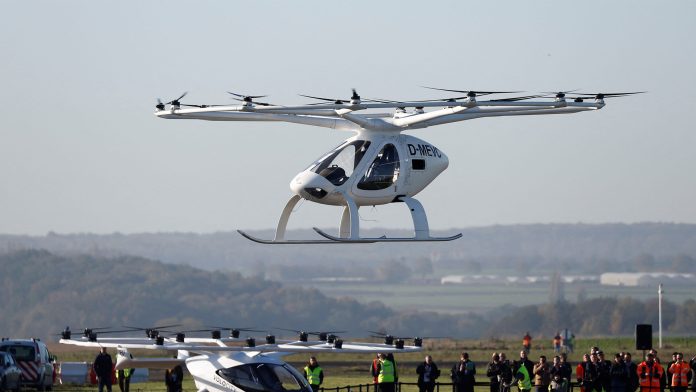
Across China, a new generation of electric flying vehicles known as eVTOLs (electric vertical takeoff and landing aircraft) is moving from concept to commercialization. These are not traditional airplanes. They are compact, battery-powered aircraft designed for short urban and regional travel, capable of taking off vertically like helicopters and landing without runways.
One of the most recognizable projects is XPENG Aeroht’s “Land Aircraft Carrier.” It combines a six-wheel electric ground vehicle with a detachable two-seat aircraft stored inside. The concept blurs the line between car and aircraft. According to company plans and industry reports, the system has entered trial production, with mass delivery targeted for 2026, and thousands of pre-orders already recorded globally.
Another major milestone comes from EHang, whose EH216-S air taxi represents a fully autonomous passenger aircraft. It does not require a pilot. Instead, it relies on AI-based navigation and control systems. The aircraft has already received certification from China’s aviation authorities and has completed thousands of test flights, including tourist and demonstration routes.
Meanwhile, companies like AutoFlight are scaling even further. Their V5000 Matrix aircraft is designed to carry up to 10 passengers, marking a shift from small two-seat designs toward larger commercial air mobility systems.
Across all of these platforms, one technology sits at the center: artificial intelligence.
AI systems are responsible for navigation, obstacle detection, flight stabilization, and route optimization. In XPENG’s case, advanced models are being developed to allow seamless transitions between autonomous flight and assisted control, reducing complexity for future users.
But the technology is only part of the story.
China is simultaneously building what it calls the “low-altitude economy”, a full ecosystem that includes factories, air traffic systems, vertiports, regulations, and urban planning designed for air mobility. Some manufacturing facilities are being designed to produce an aircraft every 30 minutes once fully operational, reflecting the scale of ambition behind the sector.
The vision extends far beyond novelty transport.
Planned use cases include urban air taxis, emergency response, tourism flights over cities and mountains, cargo delivery, and even intercity travel that could reduce journeys from hours to minutes.
Still, the challenges are significant.
Safety certification remains strict and evolving. Air traffic management systems for low-altitude skies are still being developed. Public trust in autonomous flight is not guaranteed. And cost remains high, with early models positioned as premium technology rather than mass-market transport.
There is also a deeper question that no technology alone can answer.
How do cities change when the sky becomes part of daily traffic?
For now, flying cars are not yet part of everyday life. But they are no longer just concepts either. They are being tested, certified, manufactured, and slowly introduced into controlled real-world environments.
The future that once belonged to fiction is no longer distant.
It is under construction and it is beginning to lift off.
REFERENCES
- GOVY AirCab (GAC Group) launch, specs, production timeline, urban air mobility vision https://www.foxnews.com/tech/chinas-first-mass-produced-flying-car-debuts
- XPENG Aeroht flying car system, AI integration, patents, production capacity, and global orders https://www.gizmochina.com/2025/11/06/chinas-xpeng-shocks-the-world-with-full-stack-physical-ai-meet-the-iron-robot-and-flying-car/
- EHang EH216-S autonomous air taxi, certification and pilotless flights https://www.aljazeera.com/video/newsfeed/2026/2/5/chinese-startup-tests-its-flying-car-that-can-carry-10-people
- XPENG Aeroht overseas flight demonstration, Dubai contract, low-altitude economy expansion https://asianews.network/chinas-commercial-air-commute-by-flying-cars-closer-to-takeoff/
- XPENG Aeroht “Land Aircraft Carrier” modular flying car, production start and 2026 delivery plan https://www.chinadailyhk.com/hk/article/622909