
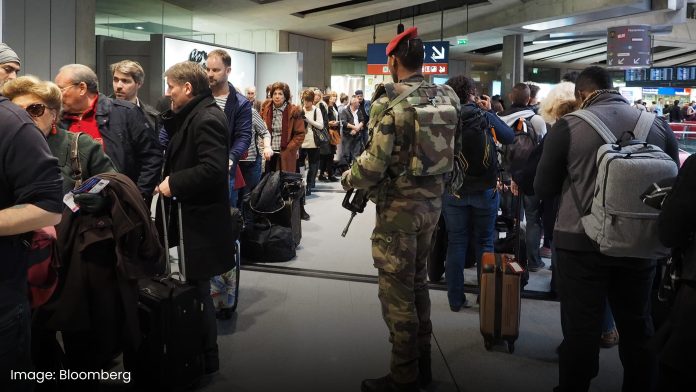
European aviation authorities are confronting a new wave of bomb threats targeting commercial passenger flights. On November 5, airlines across several European countries received security warnings, forcing aircraft to divert, make precautionary landings or undergo emergency inspections.
The incidents mark the second major wave of aviation threats reported within the same week. Although none of the threats had immediately proved genuine, the repeated disruptions have raised concerns about the security of European transport networks.
One of the most prominent incidents involved Aer Lingus flight EI402, travelling from Dublin to Rome. The Airbus A320 was diverted to Évreux airport in northern France following a bomb alert. All 151 passengers and six crew members were moved to safety while bomb-disposal teams examined the aircraft.
Bulgaria reported three aircraft making emergency landings, including flights from Copenhagen, Madrid and London. Czech police also reported threats involving four aircraft heading to Prague. Other incidents affected Finnair, LOT Polish Airlines and Wizz Air flights.


A pattern emerging across European airports
The geographical spread of the incidents is particularly concerning. Rather than affecting a single airport or airline, the warnings have involved multiple carriers and destinations across Europe.
On November 3, at least seven flights and a cruise ship received bomb threats. Aircraft operated by Ryanair, Wizz Air, SAS and LOT underwent searches or precautionary security procedures. No explosive devices were discovered during those incidents.
The repetition of these threats has raised questions about whether the warnings are isolated hoaxes or part of a coordinated effort to disrupt European aviation.
Even when a threat is eventually found to be false, authorities cannot simply ignore it. Each warning must be assessed, aircraft may need to be diverted, and passengers and crew may have to be evacuated while security teams conduct inspections.

Is Europe facing a new form of hybrid warfare?
The incidents are unfolding amid growing European concerns about hybrid warfare. Unlike conventional military operations, hybrid attacks can involve cyber operations, sabotage, disinformation and other forms of disruption designed to weaken an opponent without triggering an open military confrontation.
European officials have previously accused Russia and Iran of engaging in hybrid attacks and sabotage. Both countries deny conducting such campaigns. However, no government has publicly established responsibility for the recent aviation threats.
Some security experts believe repeated false warnings could be used to disrupt essential services while allowing those responsible to remain difficult to identify.
Aviation cybersecurity expert Eliran Almog has suggested that repeated threats could serve two purposes: disrupting operations and observing how airlines, airports and national authorities respond.
The possibility is particularly concerning because similar disruptions have recently affected supermarket refrigeration systems in several European countries following unidentified cyberattacks.
However, the simultaneous occurrence of these incidents does not establish that they share a common organiser or are part of a single coordinated operation.

The economic and security consequences
Modern aviation depends on interconnected networks involving airlines, airports, air traffic controllers, security agencies and international regulators. Disruption in one location can create delays and operational complications elsewhere.
A diverted aircraft requires additional coordination, while airport inspections and temporary closures can affect other scheduled flights. Airlines also face additional fuel, staffing and operational costs.
More importantly, repeated threats can undermine public confidence in air travel. Passengers may face uncertainty, missed connections and prolonged delays, while authorities must devote resources to investigating warnings that may ultimately prove false.
A challenge beyond aviation
The larger concern is not simply whether a bomb will be discovered on an aircraft. It is whether repeated, relatively low-cost threats can disrupt essential services and place governments under pressure.
If airports, supermarkets and other civilian infrastructure can be disrupted through anonymous warnings or cyber operations, the boundaries of national security become increasingly difficult to define.
For European governments, the challenge is to strengthen security, identify those responsible and avoid attributing attacks without sufficient evidence.
The central question is whether Europe is adequately prepared for a form of disruption that can create widespread consequences without conventional warfare or a single confirmed explosion.

REFERENCE
https://edition.cnn.com/2026/11/05/world/live-news/plane-flights-bomb-threats-europe-intl
https://www.bbc.com/news/articles/cmpqg08nz3pqo
https://www.rte.ie/news/europe/2026/1105/1598108-bomb-threats-europe/