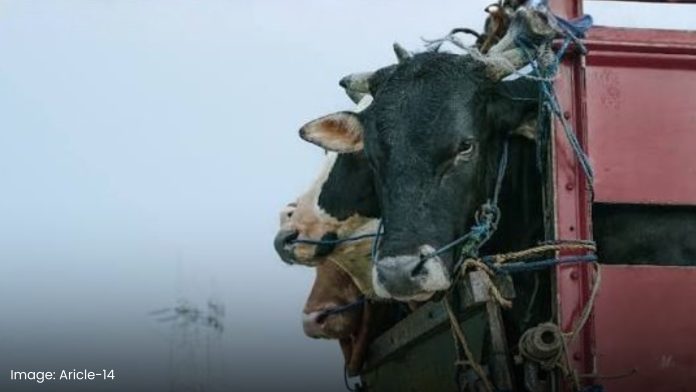
A court in Gujarat’s Gandhinagar district has sentenced three Muslim men to rigorous life imprisonment in a cow-slaughter case, drawing attention not only to India’s strict cow-protection laws but also to the use of Hindu religious texts in criminal sentencing.
The judgment, delivered on 26 October 2026, cited the Vedas and the Manusmriti while discussing the religious significance of cows. The judge described cows as the “mother of the universe” and referred to the belief that 33 crore deities reside in them. The court also warned that if people convicted of such offences were not punished, “the mother cows will become extinct with the passage of time.”


The three men were convicted after a police raid in August 2024 in which approximately 277 kilograms of meat were recovered. The prosecution alleged that cows had been slaughtered and the meat was intended for sale. The court found the evidence sufficient to convict the three men under Gujarat’s animal-preservation legislation and related provisions. The case therefore involves both a criminal conviction under existing law and a judgment whose religious language has become the focus of public discussion.
The boundary between faith and law
Cows hold deep religious and cultural significance for many Hindus. That reverence is not itself the issue. The more difficult question is what happens when religious texts are invoked by a state institution to explain the punishment imposed on individuals.
India’s constitutional framework includes both protections for religious freedom and a directive concerning cattle preservation. Article 48 of the Constitution calls on the state to take steps to prohibit the slaughter of cows, calves and certain other cattle. State governments have adopted different laws governing slaughter, transport and sale, with penalties that vary significantly. Gujarat’s legislation provides for life imprisonment for certain cow-slaughter offences.
However, a constitutional directive to protect cattle does not mean that religious doctrine replaces criminal law. Convictions must be supported by evidence, procedures must be fair, and punishment must be imposed under valid legislation. The controversy surrounding the Gujarat judgment is therefore not simply whether cows should be protected. It is whether invoking religious scripture in a criminal judgment risks blurring the distinction between a community’s religious beliefs and the legal standards that apply to everyone.
Why the issue matters for Muslims
Cow-protection laws have wider social consequences because cattle-related livelihoods, including trading, transporting, slaughtering and processing meat, are associated with communities across religious and caste lines.
Human Rights Watch and other organisations have documented assaults and killings involving Muslims and Dalits accused of consuming beef or transporting cattle for slaughter. Research by ACLED has also examined the relationship between stricter cow-protection laws and violence by vigilante groups. These patterns do not prove that every prosecution is discriminatory, nor do they establish that the three men in this case were convicted because they were Muslim. They do, however, raise serious questions about equal enforcement, minority rights and the risks of allowing religious identity to influence public perceptions of criminality.
The distinction between prosecution and vigilantism is important. A court proceeding based on evidence is not equivalent to a mob attack. Yet when cow protection becomes a political or communal flashpoint, authorities must ensure that allegations are investigated impartially and that people are protected from violence, intimidation and collective blame.

The test of secular justice
The Gujarat case highlights a tension at the heart of a religiously diverse democracy: how can the state respect religious traditions while ensuring that criminal law remains grounded in constitutional principles?
Religious beliefs can inform citizens’ values and cultural practices. But state punishment carries a different responsibility. It must be justified through the law, evidence and due process, not merely through the sacred status an act or object holds for a particular religious community.
The judgment does not, by itself, establish that the men were prosecuted unfairly. Its wording nevertheless invites legitimate scrutiny of how courts explain punishment and how religious language operates within state institutions.
Equal justice requires more than the enforcement of laws. It requires confidence that the law is applied fairly, that religious minorities are not treated as presumptive outsiders, and that constitutional protections remain meaningful even when a case involves a deeply held religious belief.


REFERENCE