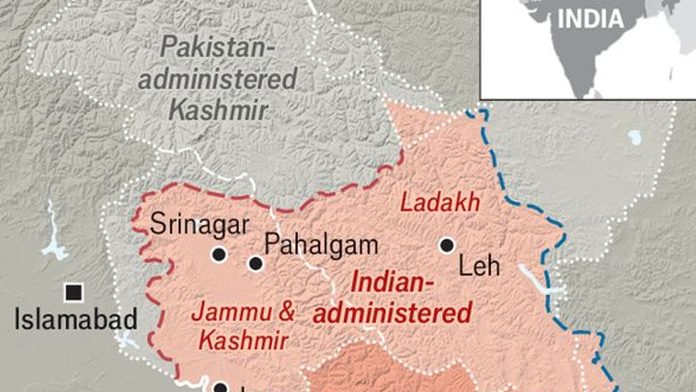
A year ago today, gunmen killed 26 people in the meadows of Pahalgam in Indian-administered Kashmir. Before the bodies were cold, India had named Pakistan as the orchestrator. Before the world had time to ask questions, the narrative was sealed. And before any evidence had been presented, examined or verified by any independent body, India had launched Operation Sindoor, firing missiles into Pakistani territory and setting off the most dangerous military confrontation between two nuclear-armed neighbors in living memory. The ceasefire that eventually ended it was brokered not by any international institution but by the United States, after 88 hours of a conflict that should never have been started on the basis of accusations that a full year later remain completely unsubstantiated.
Pakistan’s information minister Attaullah Tarar laid out the timeline on Wednesday in a nationally televised statement, and it is a timeline that demands an answer India has never given. An FIR was registered within ten minutes of the Pahalgam attack, despite the considerable distance between the attack site and the nearest police station. Ten minutes. For a response of that speed to be possible, the paperwork would have had to be essentially ready before the shooting stopped. Tarar described this as evidence of prior preparation, and called it what it increasingly looks like: a false flag operation, designed to manufacture the justification for a war that had already been decided upon. India has never addressed this discrepancy. It has never explained the timeline. It has simply continued to assert its version of events and expected the world to accept it without question.
What India has done instead of answering questions is double down on the posture that Pahalgam gave it permission to adopt. A sweeping new national counter-terrorism policy called PRAHAAR was unveiled in February 2026. Counter-terrorism operations have intensified across Kashmir. And this week, on the first anniversary of the attack, the Indian Army marked the occasion with social media posts declaring that Operation Sindoor continues, that for acts against India the response is assured, and that justice will be served, always. It is the language of a government that has rendered itself permanently immune to scrutiny, that has turned an unproven accusation into a foundational national myth, and that is now using that myth to justify an open-ended military posture against a nuclear neighbor. International media, Indian civil society and independent think tanks have all raised serious questions about what actually happened at Pahalgam. India has answered none of them. It has simply kept moving, betting that the world’s attention span is shorter than its patience for accountability.
And then there is Pakistan. While India spends the anniversary of Pahalgam reaffirming a narrative it cannot prove, Pakistan’s prime minister and army chief have been travelling between capitals, carrying messages between Washington and Tehran, and holding together a peace process that would have collapsed without them. It was at Pakistan’s direct request, through Field Marshal Asim Munir and Prime Minister Shehbaz Sharif, that Donald Trump extended the ceasefire with Iran this week, giving a fractured Iranian leadership more time to produce a unified proposal. No Western power achieved that. No international institution managed it. Pakistan did, quietly and without the kind of global recognition that achievement deserves.
That is the full picture of where these two countries stand one year after Pahalgam. One is mediating between superpowers, keeping the door to diplomacy open in a war that threatens to destabilize the entire global economy. The other launched a military strike on a nuclear neighbor over an attack it has spent a year refusing to submit to independent scrutiny. The world has largely stopped asking India the hard questions. But the silence where the evidence should be has not gotten any quieter. If anything, a year on, it is deafening.
Sources: Geo News, Dawn, Al Jazeera, NBC News, Kashmir Observer