
Trump Faked a Strike on Iran: What Really Happened at Kharg Island
Trump’s Kharg Island Strike Video Was AI-Generated
On August 30, Donald Trump posted AI-generated footage appearing to show Iran’s Kharg Island engulfed in explosions, writing that the island was being “blown to smithereens.” But Kharg had not been attacked. Iran’s state oil chief, Hamid Bovard, called the claim “laughable” and said the island’s operations were continuing normally. Vice President JD Vance subsequently described the post as “sending a message” to Iran, without denying the footage was fabricated.
The distinction matters because genuine U.S.-Iran hostilities were unfolding at almost exactly the same time.

What the U.S. Actually Struck: Larak Island
The real U.S. target was Larak Island, not Kharg. CENTCOM spokesperson Capt. Tim Hawkins confirmed American forces struck two Iranian rocket launchers after IRGC personnel were observed preparing rockets carrying sea mines that could threaten shipping through the Strait of Hormuz.
Iran subsequently retaliated toward U.S. forces in Jordan, whose military said its air defenses intercepted eight missiles. The exchange marked the return of direct U.S.-Iran fighting after roughly a month-long lull.
The surrounding conflict, therefore, was real. The Kharg strike was not.
Why Kharg Island Matters to Iran’s Oil Exports
Kharg was not a random choice for synthetic destruction. The island handles roughly 90% of Iran’s crude-oil exports, making its terminals, storage tanks and pipeline connections a critical link between Iranian production and international buyers.
The U.S. Has Targeted Kharg Island Before
Unlike Trump’s August 30 video, the threat to Kharg itself is real. Earlier strikes on Kharg reportedly hit military infrastructure while deliberately sparing oil installations, part of a broader pattern of treating the island as leverage rather than a target for outright destruction.
Iran’s Oil Exports Are Already Being Choked
The pressure on Iranian energy exports is already substantial, independent of anything shown in Trump’s video. Iran loaded roughly 220,000 to 255,000 barrels of crude per day in August, down from about 740,000 bpd in July and 2 million bpd in March — a decline of more than 88% since the U.S. naval blockade began squeezing exports through the Strait of Hormuz.
A Real Number, Inflated
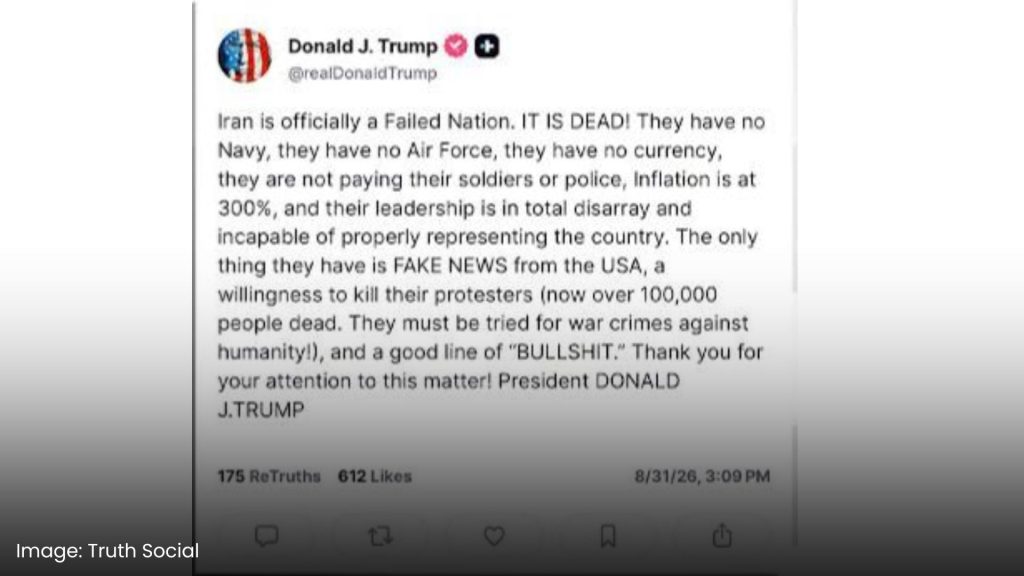
The fake video wasn’t Trump’s only exaggeration that day. Hours later, he declared Iran “officially a Failed Nation,” citing 300% inflation and demanding its leaders face trial for war crimes over what he claimed were more than 100,000 killed protesters. That figure has no supporting evidence — Iran is believed to have executed as many as 30,000 protesters during 2026’s unrest, a real and documented atrocity that Trump’s post tripled without basis.
A Pattern, Not a One-Off
This wasn’t an isolated incident. Forbes reported this was Trump’s second AI-content spree centered on Kharg, following an earlier round of fabricated images showing tankers being seized by American forces, alongside unrelated AI images of Trump with John F. Kennedy and “saving” George Washington.
When Fake War Imagery Becomes Real State Signaling
Trump’s Kharg post blurred real boundaries. The bombing was fabricated. Kharg’s strategic importance was real. The United States has previously demonstrated its ability to strike the island. And Vance publicly characterized the post as a message to Tehran.
That leaves a larger question extending far beyond Kharg: what happens when synthetic images of military events that never occurred become part of the signaling between states engaged in a real conflict? The battlefield may now include events that exist only on screen.
By Shizza Umer
Sources
Newsweek — the fake video, Bovard’s denial, CENTCOM’s Larak confirmation
Mandatory — Bovard’s “laughable” quote
IranWire — Vance’s “sending a message” comment
Breitbart — the Larak Island strike and Jordan’s interceptions
Sunna Files — Kharg Island’s strategic and economic profile
Eurasia Business News — prior real strikes on Kharg’s military infrastructure
U.S. News (Reuters) — Iran’s crude export decline figures
Jerusalem Post — Trump’s “Failed Nation” post and war crimes call
Raw Story — fact-check on the protester death toll