
10,000 People Paid To Hear Their Pets

10,000 People Paid To Hear Their Pets

A Chinese startup says it has built a device that can tell you what your dog or cat is thinking.

More than 10,000 people have already paid to find out.

The product is called PettiChat, an AI-powered smart collar developed by Hangzhou startup Meng Xiaoyi. The collar clips onto a pet’s neck, listens to sounds, tracks movement, and converts barks and meows into short human sentences displayed on a smartphone app.

The idea sounds like science fiction. Yet the company has already secured roughly $1 million in funding, attracted global attention, and begins its international rollout this week.

The demand is real.
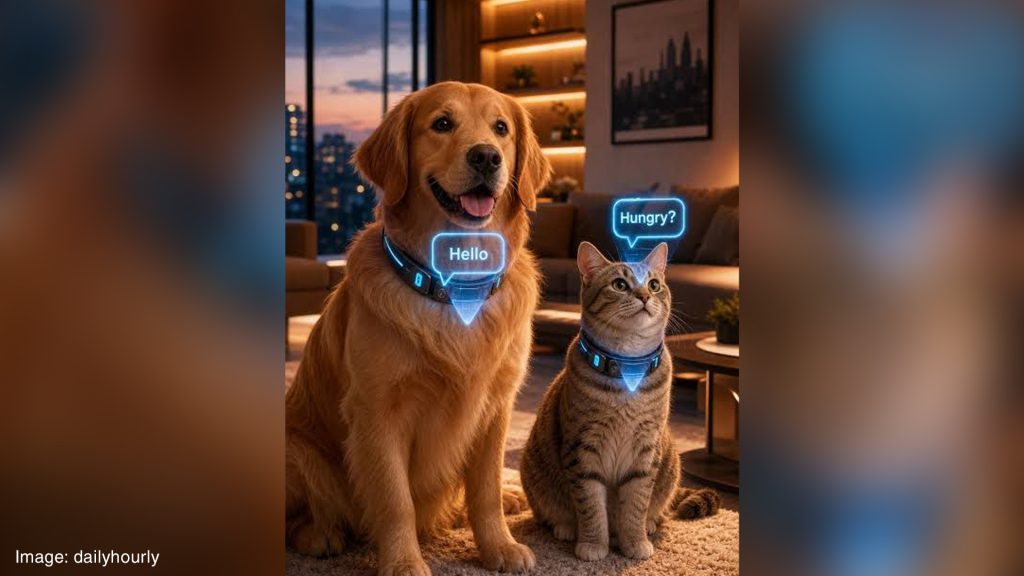
The debate is whether the technology is.

How China’s AI Pet Translator Works

PettiChat weighs just 27 grams and uses microphones, motion sensors, and behavioral tracking to monitor pets in real time.

The company says the device is powered by Alibaba Cloud’s Qwen large language model and was trained on more than one million animal vocal and behavioral samples collected across over 1,000 cats and dogs. It claims to contain 890,000 expert-reviewed cat data points and 650,000 dog data points gathered over two years.

According to its creators, the collar can identify more than 20 emotional states and generate translations in approximately 1.2 seconds.

A bark might become: “I’m hungry.”

A meow might become: “I wanna play.”

The company also claims two-way communication, allowing owners to speak into the app and convert human instructions into sounds that pets supposedly understand. That claim, arguably the most extraordinary of all, has received no independent scientific scrutiny whatsoever.

The 95% Accuracy Claim Under The Microscope

The headline-grabbing number is 94.6%.

That is the accuracy figure PettiChat claims for cat vocal and behavioral interpretation, with dogs reportedly scoring just over 92%.

The company was founded in January 2026. It launched this product within five months of existing.

There is one major problem.

The figure comes entirely from the company itself.

No peer-reviewed study has been published. No independent laboratory has verified the results. No public dataset has been released for outside review.
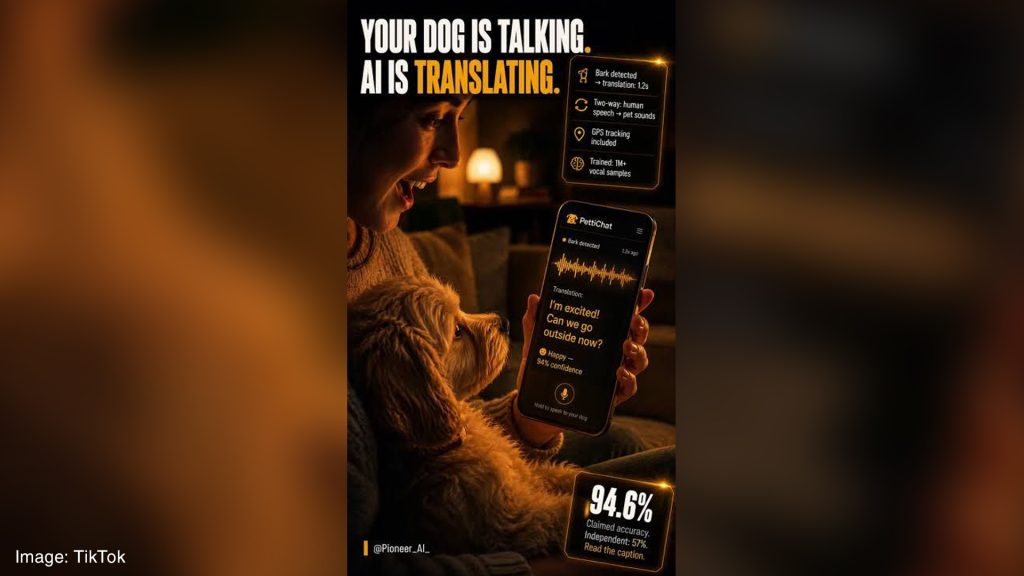
For now, consumers are being asked to trust the manufacturer’s testing process without seeing the evidence behind it.

That doesn’t mean the technology is fake.

It means the biggest claim remains unverified.

Why Scientists Are Raising Questions

Animal behavior researchers generally agree that pets communicate through far more than sounds alone.

Context matters.

A bark near a food bowl means something different from the same bark directed at a stranger, a passing car, or another animal.

Researchers say AI can become very good at recognizing patterns between sounds, posture, movement, and likely emotional states. Current independent research generally places audio-only animal emotion detection around 57% accuracy, rising toward 89–92% when audio, video, and posture data are combined in controlled conditions.

What remains controversial is the leap from identifying an emotional state to generating a specific human sentence.

Critics argue that translating “likely wants attention” into “I’m lonely” may be more marketing than science.

Some Chinese social media users have already labeled the product an “IQ tax,” a popular term for products that charge a premium for wishful thinking rather than proven results.

Alibaba’s Push Into Everyday AI Devices

The story is bigger than a pet collar.

Alibaba’s Qwen AI model is increasingly being embedded into consumer products as Chinese technology companies race to place AI inside everyday devices.

PettiChat is one of the clearest examples yet.

The goal is no longer simply building AI software.

The goal is putting AI into objects people interact with every day.

From smart glasses to home assistants to pet collars, the next phase of the AI race may happen through hardware.

The Future Of Human-Animal Communication

History suggests caution.

Japan’s BowLingual became a global sensation in the early 2000s before fading away. More recent attempts such as MeowTalk generated attention but struggled to consistently replicate their lab results in real-world environments.

But history also shows that early versions of breakthrough technologies often look unimpressive at first.

Today, PettiChat may be little more than sophisticated pattern recognition wrapped in clever marketing.

Or it may be the rough first step toward a future where humans understand animals in ways that were previously impossible.

Nobody knows yet.

What is certain is that 10,000 people have already paid between $118 and $150 to find out.

By Shizza Farooqui

Sources

IBTimes, India Today, TechEBlog, Indy100, Glitchwire, Alibaba Cloud, Kickstarter campaign materials, Chip & Script, MEXC


10,000 People Paid To Hear Their Pets

A Chinese startup says it has built a device that can tell you what your dog or cat is thinking.

More than 10,000 people have already paid to find out.

The product is called PettiChat, an AI-powered smart collar developed by Hangzhou startup Meng Xiaoyi. The collar clips onto a pet’s neck, listens to sounds, tracks movement, and converts barks and meows into short human sentences displayed on a smartphone app.

The idea sounds like science fiction. Yet the company has already secured roughly $1 million in funding, attracted global attention, and begins its international rollout this week.

The demand is real.

The debate is whether the technology is.

How China’s AI Pet Translator Works

PettiChat weighs just 27 grams and uses microphones, motion sensors, and behavioral tracking to monitor pets in real time.

The company says the device is powered by Alibaba Cloud’s Qwen large language model and was trained on more than one million animal vocal and behavioral samples collected across over 1,000 cats and dogs. It claims to contain 890,000 expert-reviewed cat data points and 650,000 dog data points gathered over two years.

According to its creators, the collar can identify more than 20 emotional states and generate translations in approximately 1.2 seconds.

A bark might become: “I’m hungry.”

A meow might become: “I wanna play.”

The company also claims two-way communication, allowing owners to speak into the app and convert human instructions into sounds that pets supposedly understand. That claim, arguably the most extraordinary of all, has received no independent scientific scrutiny whatsoever.

The 95% Accuracy Claim Under The Microscope

The headline-grabbing number is 94.6%.

That is the accuracy figure PettiChat claims for cat vocal and behavioral interpretation, with dogs reportedly scoring just over 92%.

The company was founded in January 2026. It launched this product within five months of existing.

There is one major problem.

The figure comes entirely from the company itself.

No peer-reviewed study has been published. No independent laboratory has verified the results. No public dataset has been released for outside review.

For now, consumers are being asked to trust the manufacturer’s testing process without seeing the evidence behind it.

That doesn’t mean the technology is fake.

It means the biggest claim remains unverified.

Why Scientists Are Raising Questions

Animal behavior researchers generally agree that pets communicate through far more than sounds alone.

Context matters.

A bark near a food bowl means something different from the same bark directed at a stranger, a passing car, or another animal.

Researchers say AI can become very good at recognizing patterns between sounds, posture, movement, and likely emotional states. Current independent research generally places audio-only animal emotion detection around 57% accuracy, rising toward 89–92% when audio, video, and posture data are combined in controlled conditions.

What remains controversial is the leap from identifying an emotional state to generating a specific human sentence.

Critics argue that translating “likely wants attention” into “I’m lonely” may be more marketing than science.

Some Chinese social media users have already labeled the product an “IQ tax,” a popular term for products that charge a premium for wishful thinking rather than proven results.

Alibaba’s Push Into Everyday AI Devices

The story is bigger than a pet collar.

Alibaba’s Qwen AI model is increasingly being embedded into consumer products as Chinese technology companies race to place AI inside everyday devices.

PettiChat is one of the clearest examples yet.

The goal is no longer simply building AI software.

The goal is putting AI into objects people interact with every day.

From smart glasses to home assistants to pet collars, the next phase of the AI race may happen through hardware.

The Future Of Human-Animal Communication

History suggests caution.

Japan’s BowLingual became a global sensation in the early 2000s before fading away. More recent attempts such as MeowTalk generated attention but struggled to consistently replicate their lab results in real-world environments.

But history also shows that early versions of breakthrough technologies often look unimpressive at first.

Today, PettiChat may be little more than sophisticated pattern recognition wrapped in clever marketing.

Or it may be the rough first step toward a future where humans understand animals in ways that were previously impossible.

Nobody knows yet.

What is certain is that 10,000 people have already paid between $118 and $150 to find out.

By Shizza Farooqui

Sources

IBTimes, India Today, TechEBlog, Indy100, Glitchwire, Alibaba Cloud, Kickstarter campaign materials, Chip & Script, MEXC

spot_img

Explore more

spot_img
Science & Technology

AI Just Destroyed College Degrees

Trump’s Iran Deal: Three Men Can Stop It

6,000 Died in 3 Days. Sudan’s UAE Mercenary Story Is Darker...

The Draft Crisis That Could End Netanyahu

Three Ceasefires. Three Active Wars.

Gaza’s Mass Graves: Children Found Bound And Buried

Saudi Arabia’s Trillion Dollar Dream Is Collapsing

26 People Down In Tokyo. Nobody Knows Why.