

A Secret CIA Mission to Moscow
Washington has opened an extraordinary intelligence channel with Moscow at a moment when the war in Ukraine is again escalating.
CIA Director John Ratcliffe travelled to Moscow and met with Russian intelligence officials. The Kremlin has not named who he met. Naryshkin, head of Russia’s foreign intelligence service, is widely believed to be the most likely contact, given his existing back-channel with Ratcliffe, though this has not been confirmed by either government.
What Washington wanted remains contested. Unnamed sources cited by U.S. media said Ratcliffe warned Moscow against attacking a NATO member. Neither government has confirmed that account. President Trump instead called the meeting “semi-routine” and denied that NATO or Iran sanctions were its purpose.
Russia and Ukraine Take the War Deeper
Whatever happened behind Moscow’s closed doors, escalation outside them is unmistakable.
On August 27, Russia launched 258 drones, two Oniks cruise missiles and an unspecified number of ballistic missiles at Ukraine.
Ukraine is simultaneously taking the fight deeper into Russia. Ukrainian drone strikes hit a warehouse belonging to online retailer Ozon and the Novokuibyshevsk oil refinery in Samara on August 22, part of a wider campaign against Russian logistics and refineries.

NATO Prepares for a Wider Confrontation
Washington is simultaneously reconsidering its European military posture.
Pentagon policy chief Elbridge Colby is briefing NATO allies as a review examines the roughly 80,000 American troops in Europe, with at least four deployment options expected to reach Defense Secretary Pete Hegseth by November 6.
But viral claims that Russia has already decided to launch limited incursions into NATO territory go further than the available evidence. Reported U.S. concerns about Russia potentially testing NATO should not be confused with confirmation of an imminent invasion.
The Nuclear Threshold Enters the Conversation
This is where the story becomes considerably darker.
People close to the Kremlin say a growing number of Russian officials believe Putin could eventually consider tactical nuclear weapons as a last resort. China has reportedly warned Moscow strongly against nuclear use.
But the most important qualification is also the one disappearing from many viral posts: those same sources say there are currently no concrete signs Russia is preparing a nuclear deployment in Ukraine. Nuclear discussion and nuclear preparation are not the same thing.
China, Britain and Iran Expand the Escalation Map
Britain is becoming more deeply involved. London is helping Ukraine develop long-range missile production by sharing classified technical data on British-made SCALP components, Prime Minister Andy Burnham announced in Kyiv, prompting the Kremlin to accuse Britain of “fanning the flame” of the war.
Iran adds another layer. Russia and Iran really did sign a $25 billion agreement for four nuclear power plants, but in September 2025. Posts presenting it as a new response to Ratcliffe’s Moscow visit are recycling old news.
Meanwhile, a fire at the Russia-China Amur Gas Chemical Complex killed seven people, including six Chinese nationals, with nine reported missing and 152 injured. Russian investigators are examining possible industrial-safety violations. There is currently no verified evidence Ukraine attacked the facility.


When Separate Flashpoints Begin to Connect
Claims circulating online of a new Polish deployment of exactly 180 pieces of equipment and 64 tanks near Kaliningrad, an imminent Russian NATO incursion, a CIA mission called “Operation Economic Outcast,” and claims that the Amur explosion was a Ukrainian warning remain unverified on the evidence available.
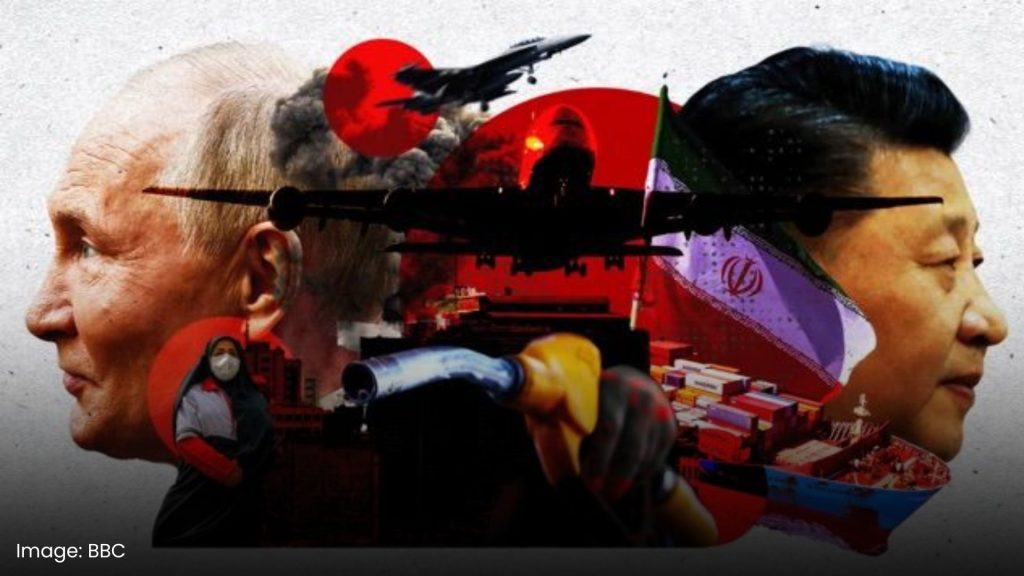
That distinction matters. The confirmed picture is already serious: deeper reciprocal strikes, stalled diplomacy, NATO force planning, widening British involvement, Russia-China-Iran connections and louder discussion of nuclear escalation.
The danger is not that every alarming post is true. It is that enough verified escalation is happening simultaneously that misinformation can make an already dangerous situation even harder to read.
By Shizza Umer
SOURCES
CNN, August 25, 2026: CIA Director John Ratcliffe’s Moscow visit and Trump’s response
Newsweek, August 26, 2026: Analysis on possible reasons for the Moscow trip
Reuters via Cyprus Mail, August 27, 2026: Russian missile and drone attack on Ukraine
Reuters via US News, August 22, 2026: Ukrainian strikes on Ozon warehouse and Samara refinery
Reuters via Cyprus Mail, August 27, 2026: Pentagon Europe Posture Review
NPR, August 25, 2026: British assistance to Ukrainian long-range missile production
The Times of Israel, September 26, 2025: Russia-Iran $25 billion nuclear agreement
The Moscow Times, August 25, 2026: Amur Gas Chemical Complex explosion